

What Is Smart Monitoring? And Why Traditional Methods Are No Longer Enough
- Watchman Tower Team
- Updated: October 1, 2026
- Category: Smart Monitoring
- Read Time: 5 min
Smart monitoring means alerts that carry context: a failure is confirmed, compared with how the site normally behaves, and read together with other signals. This guide explains what that looks like and where AI realistically fits.
Traditional monitoring asks one question: is it up? That question still matters, but it leaves two problems unsolved. Teams get too many alerts that mean nothing, and they miss the slowdowns and partial failures that never show up as "down".
Smart monitoring is the name usually given to the approach that addresses both. This guide explains what it means in practice, what it does not mean, and where AI realistically fits.
What Is Smart Monitoring?
Smart monitoring is monitoring that uses context to decide what deserves attention. Instead of treating every failed check or crossed threshold as an alert, it asks a few more questions first:
- Is the failure real? Was it confirmed by a retry and from more than one location?
- Is it unusual for this site? How does it compare with the site's own history?
- What else changed? Did response time, error rate or server resources move at the same time?
- Who needs to know, and how urgently?
The goal is not more data. It is fewer, better alerts, each one with enough context to act on.
Why Traditional Monitoring Falls Short
Basic monitoring tends to fail in one of two directions.
| Problem | Cause | Result |
|---|---|---|
| Too much noise | Every failed request and every brief spike triggers an alert | People stop reading alerts, and the real one is missed |
| Too little insight | Only availability is checked, from one location, against fixed limits | Slowdowns, regional failures and expiring certificates go unnoticed |
Fixed thresholds, single-location checks and simple status pings were designed for simpler systems. A site that depends on APIs, a CDN, third-party scripts and a global audience has more ways to be partly broken than a single check can see.
The Building Blocks
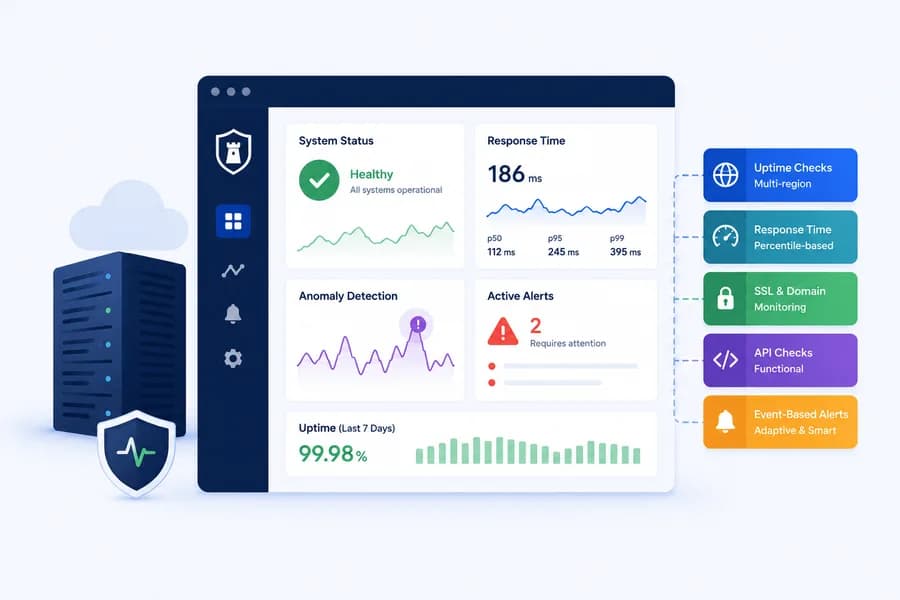
Smart monitoring is not one feature. It is a combination of layers that give each other context.
- Uptime checks from more than one location, so a regional or network problem is not mistaken for a full outage.
- Response time history, including the slowest requests and not just the average. See average response time vs percentile metrics.
- SSL and domain expiry tracking, which turns two common causes of sudden outages into warnings weeks in advance.
- Functional checks on critical flows, because a page can return 200 while the feature behind it is broken. See API functional checks.
- Confirmation and recovery logic: an incident opens after a confirmed failure and closes after consistent recovery, so a site that flaps does not produce a stream of alerts.
- Severity-based routing: confirmed outages reach people immediately, low-priority warnings wait for review.
How monitoring tools detect downtime walks through these layers in order.
Where AI Fits, and Where It Does Not
AI-driven monitoring, often called AIOps, applies machine learning to operational data. It is a real and useful direction, and it is also heavily oversold. It helps to separate the two.
What It Does Well
- Anomaly detection. Learning a metric's normal range for each hour and day, and flagging values that fall outside it, without a hand-set threshold.
- Alert correlation. Grouping many related alerts into one incident, which matters most in large systems where a single failure triggers hundreds of symptoms.
- Prioritization. Ranking incidents by likely impact, based on how similar past incidents developed.
- Root cause hints. Pointing to the component or change most likely responsible, as a starting point for investigation.
What It Does Not Do
- It does not predict outages in general. It can extrapolate trends such as a disk filling up or latency climbing. A failed deployment, an expired certificate or a provider outage is not in the historical pattern.
- It does not work without good data. A model trained on noisy or incomplete monitoring data produces noisy conclusions.
- It does not replace the basics. If failures are not confirmed and alerts are not routed sensibly, adding a model on top gives faster access to the same confusion.
Automated remediation, where a system restarts a service or scales capacity by itself, is valuable in mature environments with well-understood failure modes. For most teams, a trustworthy alert that reaches the right person quickly delivers most of the benefit with far less risk.
Who Needs Which Level
For a large platform with thousands of services and millions of metrics, machine learning is often the only practical way to make sense of the volume. For a business running a handful of sites, or an agency running a few hundred, the gains come from the building blocks above: confirmed failures, response time history, expiry tracking and clear routing. Those are rule-based, explainable, and available without a data science team.
What You Avoid
- Alert fatigue. When alerts are almost always real, they get acted on.
- Late discovery. Performance regressions show up as a trend, not a customer complaint.
- Preventable outages. Certificates and domains are renewed before they expire.
- Guesswork during incidents. Related signals are visible together, so diagnosis starts from evidence.
Who Benefits Most
- SaaS platforms, where reliability is part of the product
- E-commerce stores, where slow or broken checkout costs revenue directly
- Developer APIs, where other businesses depend on your response times
- Agencies and teams responsible for many sites, where noise multiplies with every site added
How Watchman Tower Approaches It
Watchman Tower brings uptime, response time, SSL, domain expiry and server monitoring into one place, so a failure can be read alongside the signals around it. Failures are confirmed before an alert is sent, incidents are tracked through to confirmed recovery, and alerts are delivered by email, mobile push, Slack, SMS or webhook. The aim is the practical version of smart monitoring: fewer alerts, each one worth reading.
Conclusion
Smart monitoring is not about having more data or newer technology. It is about context: confirming that a problem is real, understanding whether it is unusual, and telling the right person in time. Start with the building blocks. Add machine learning when the volume of data justifies it, not before.
Free plan available. No credit card needed.