
Multi‑channel Alerts
- Updated: October 2, 2026
- Read Time: 3 min
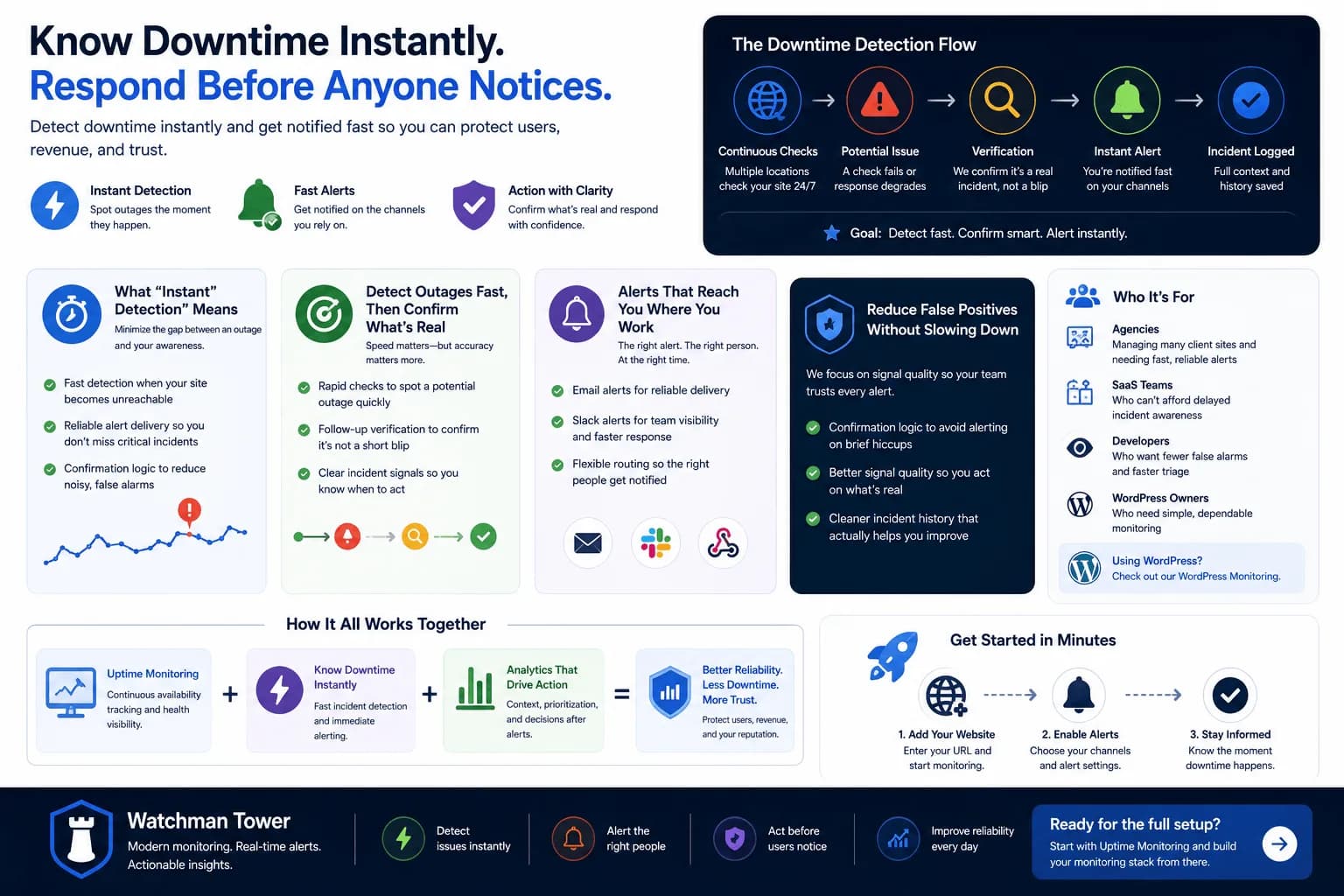
Watchman Tower sends incident alerts by email, mobile push, Slack and SMS, confirms failures before alerting, and tells you when a site recovers and how long it was down.
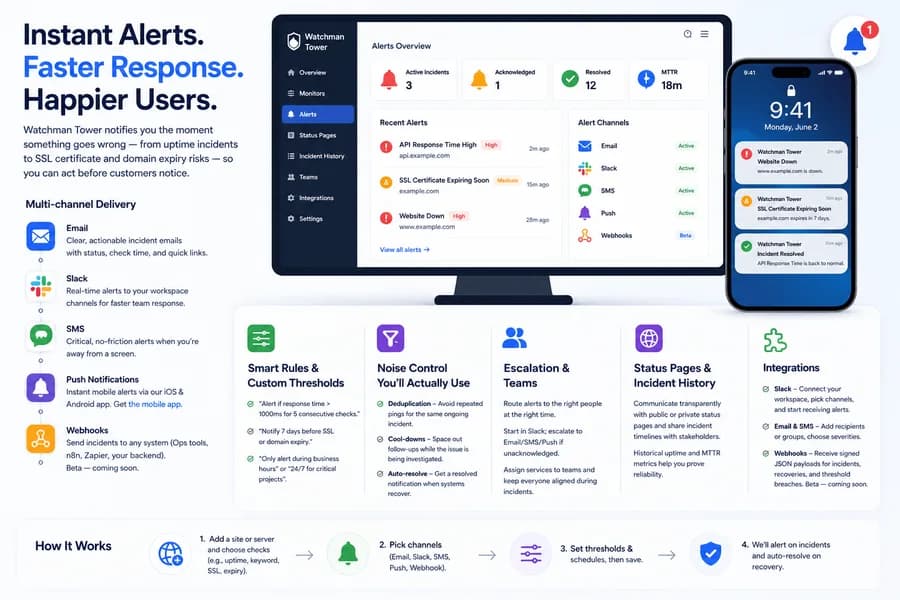
Stay ahead of issues with instant, reliable alerts. Watchman Tower notifies you the moment something goes wrong — from uptime incidents to SSL certificate and domain expiry risks — so you can act before customers notice.
Multi-channel Delivery
- Email – Incident emails that say what failed, from which regions, and when, with a link to the monitoring page. Available on every plan.
- Push Notifications – Mobile alerts through the Watchman Tower app. Available on every plan. Get the mobile app.
- Slack – Connect your workspace and choose a channel for each site and alert type. Available on the Team and Stack plans.
- SMS – Text alerts to the verified phone number on your account. Available on the Team and Stack plans.
SSL and domain expiry reminders are sent by email and mobile push.
What You Can Configure
Alerting is set up per site, and each person with access to a site has their own settings.
- Alert types – Turn availability, WordPress and server alerts on or off for each site.
- Channels per alert type – Choose which of your channels each alert type uses.
- Check interval – Every 5 minutes on the Free plan, down to 1 minute on Solo and Team, and 30 seconds on Stack.
- Request headers and timeout – Add custom headers to the check request and set how long a check waits for a response.
- Server alert thresholds – For monitored servers, define your own rules for CPU, memory, disk and network usage, with a duration the value must hold and a cooldown between alerts.
Website incident rules are not user-defined. An incident opens when checks from three regions confirm the failure, as described below. SSL and domain reminders follow a fixed schedule: 30, 14, 7, 3 and 1 day before expiry.
Noise Control You’ll Actually Use
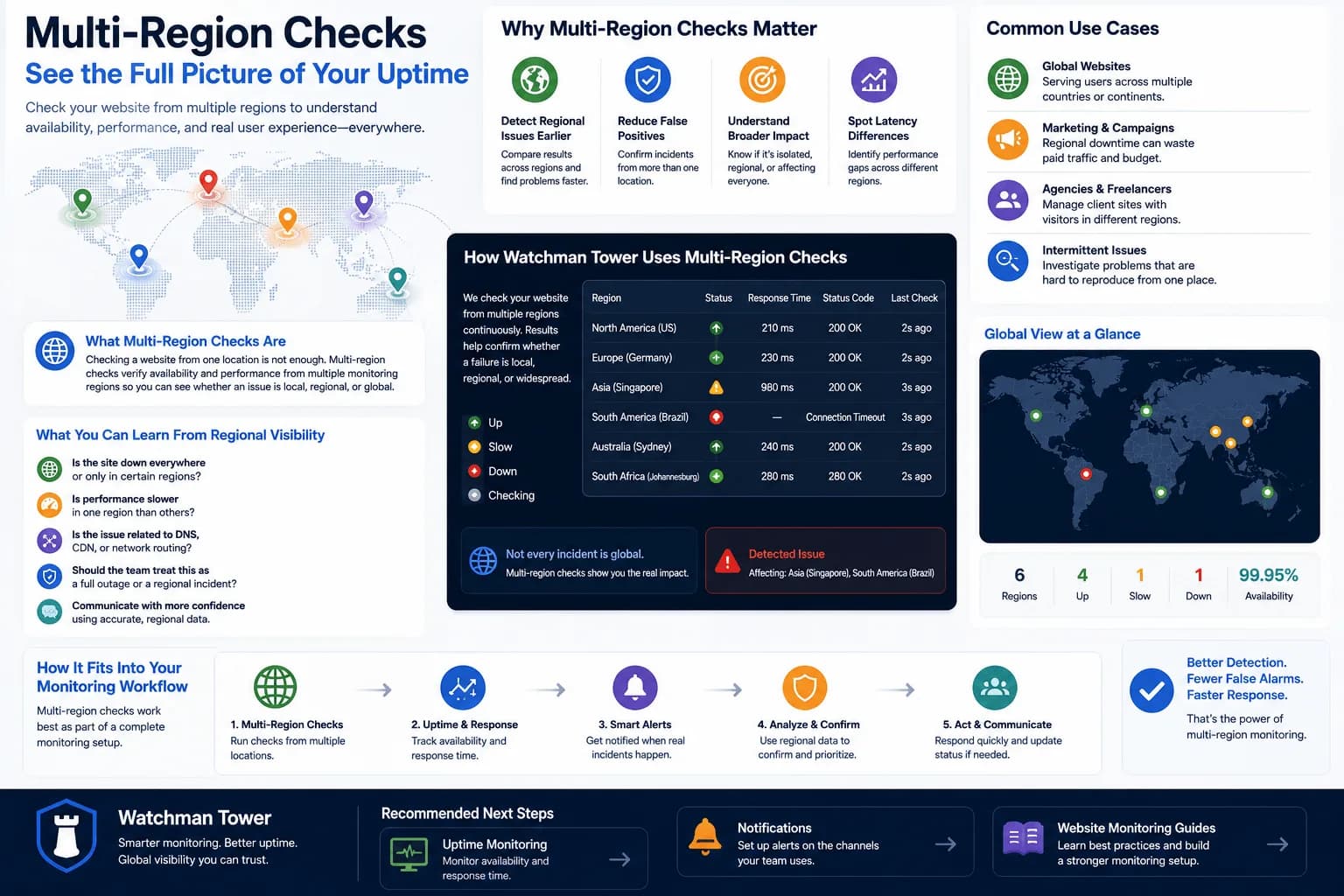
- Confirmation before alerting – Every site is checked from Frankfurt, New York and Singapore. An outage seen from all regions alerts immediately. A failure seen from one region, or a partial one, has to repeat across consecutive checks before an incident opens.
- One alert per incident – You are notified once when an incident opens and once when it resolves. If the site fails again within minutes of recovering, the same incident reopens instead of a new one starting.
- Delayed warnings – Lower-severity incidents wait 5 to 15 minutes before notifying. If the problem clears in that time, nothing is sent.
- Frequent short outages – When a site has dropped briefly four or more times in a week, short outages stop being reported one by one. A new outage is reported only if it lasts longer than 15 minutes. You are told when this starts and when it ends.
- Recovery notices – When a site recovers, the notification says how long the incident was open.
Teams
Team members and collaborators with access to a site receive its alerts, each through their own channels and settings. There is no acknowledgement step or escalation chain: every active channel is notified at the same time.
Status Pages & Incident History
Communicate transparently with a public status page. It shows a 30-day uptime figure for each component and, if you enable it, recent incidents with their start time, end time and duration.
Integrations
- Slack – Connect your workspace, pick a channel, and start receiving alerts.
- Mobile app – Push notifications that open the affected site directly.
- Public API – Create API keys to add and list sites and read response-time data.
How It Works
Check your website's health in seconds
Uptime · Response time · SSL · Domain expiry · WordPress detection
Free plan available. No credit card needed.