


Free Uptime Monitor: How to Monitor Your Website Without Paying
- Watchman Tower Team
- Updated: October 9, 2026
- Category: Website Monitoring
- Read Time: 6 min
A free uptime monitor checks your URL on a schedule and alerts you when it stops responding. This guide shows the fastest setup, compares a one-off checker with a free monitoring plan, and explains where free monitoring falls short.
A free uptime monitor checks your website on a schedule from an external server and alerts you when it stops responding. Setting one up takes a few minutes: add your public URL, choose a check interval, and connect an alert channel you actually read. That gives you a basic safety net: if the site becomes unreachable, you find out before users, clients, or search engines do.
Free uptime monitoring is a good first layer. It is not the same as a full reliability workflow. This guide explains what to set up first, how a one-off checker differs from a free monitoring plan, what free checks usually catch, and when it is time to move toward broader uptime monitoring. If you are new to the topic, start with what website monitoring is.
Quick free uptime monitor setup
If you want the shortest path, start here:
- Open a free uptime checker or monitoring tool.
- Enter the website URL you want to test.
- Run an immediate check to confirm the site responds.
- Create a recurring monitor if the tool supports it.
- Choose an alert channel such as email or push notifications.
- Test the alert path so you know who receives the notification.
You can run a one-off availability test with the Watchman Tower Free Uptime Check. If the site matters beyond a quick test, create ongoing monitoring so failures are tracked over time.
One-off checker vs free monitoring plan
“Free uptime monitor” can mean two different things. A one-off checker tells you whether the site is up right now. A free monitoring plan keeps checking and alerts you when it goes down later. Most sites need the second.
| Question | One-off uptime checker | Free monitoring plan | Paid monitoring plan |
|---|---|---|---|
| What it answers | Is the site up right now? | Did the site go down while I was not looking? | Who needs to act, how fast, and why did it fail? |
| Runs | Once, on demand | On a fixed schedule | On a shorter schedule |
| Alerts | None, or a single report | Basic channels such as email | More channels and routing |
| History | None | Short | Longer, with trends |
| Good for | A quick test before launch | Small sites and side projects | Revenue, client and production sites |
| Watchman Tower option | Free Uptime Check: instant scan plus an optional 24-hour report by email | Free plan: up to 10 sites, 5-minute checks, email and push alerts | Paid plans from $5.99/month |
What free uptime monitoring can catch
Free uptime checks are best at obvious availability problems. They can help you detect:
- a homepage that stops responding;
- a landing page that returns a server error;
- a public endpoint that times out;
- a site that becomes unreachable between manual checks;
- basic DNS, SSL, or network symptoms if the tool supports those checks.
That makes free monitoring useful for small websites, early product pages, client previews, personal projects, and non-critical marketing pages.
How free uptime checks usually work
Most free tools work by sending a scheduled request from an external monitoring system. If the response fails, times out, or does not match the expected rule, the tool marks the check as failed and may send an alert.
A basic setup is enough to answer “is this URL reachable?” A stronger setup asks more questions: how long did it take to respond, did the failure happen from more than one location, did SSL or domain health contribute, and who should respond?
Free uptime monitoring limits
Free plans are useful because they remove friction, but they usually include trade-offs. The exact limits depend on the platform, but common constraints include:
- Slower check intervals: a 5-minute interval means an outage can run for several minutes before the first failed check.
- Fewer monitors: you may only cover the homepage instead of key user journeys.
- Limited alert channels: email may be available while SMS, phone, or advanced routing require a paid plan.
- Shorter history: incident review and trend analysis may be limited.
- Less context: a free check may report that something failed without explaining why.
This is why free monitoring should be treated as the beginning of the workflow, not the final operating model.
What to monitor first
Start with the URLs that would create the most visible damage if they failed:
- homepage
- login page
- checkout or payment flow
- signup or demo request page
- API health endpoint
- status page
- high-value campaign landing pages
If you are unsure where to begin, read the full uptime monitoring guide and then use the 12-step checklist.
When free monitoring is enough
Free monitoring may be enough when the site is low-risk, the required response time is relaxed, and one or two basic alerts are sufficient. Examples include personal sites, small content projects, internal demos, and early-stage landing pages.
The key is honesty about impact. If downtime would not immediately affect revenue, customer trust, client obligations, or operational response, a free setup can be a reasonable first step.
When to move beyond free uptime checks
Upgrade the workflow when the cost of missing or delaying an incident becomes meaningful. Common signs include:
- the site supports sales, signups, paid campaigns, or client work;
- alerts need to reach more than one person;
- you need faster detection than the free interval provides;
- you need SSL, domain, API, port, or keyword checks alongside homepage monitoring;
- you need incident history, response-time trends, or status-page communication;
- you want fewer false positives through confirmation from more than one location.
At that stage, the question changes from “can I check this for free?” to “can the team respond quickly and confidently when it fails?”
Watchman Tower as a free uptime monitor
Watchman Tower’s free plan monitors up to 10 websites with 5-minute checks and sends email and push alerts, so you can cover a homepage, a login page and a few key landing pages without paying. Uptime logs are kept for 7 days on the free plan.
When the site becomes more important, paid plans add more monitoring depth and longer history. Many teams start with one URL and one alert, then later discover they need cleaner escalation, better incident history, and more context around what actually failed.
Free uptime monitoring checklist
- Add the most important public URL first.
- Set an alert channel you actually check.
- Test a failure notification before relying on it.
- Add SSL or domain-expiry monitoring if available.
- Review incident history after the first few alerts.
- Upgrade the workflow when detection speed or response confidence becomes important.
For alert design, see uptime alerts and escalation. For a broader product comparison, see best website monitoring tools.
Bottom line
A free uptime monitor is worth setting up because it moves you from guessing to knowing. It can catch obvious outages and help you build an initial alert habit. Just do not confuse a free checker with a mature reliability workflow.
Start with a free check, protect your most important URLs, and expand only when the site’s importance justifies better detection, better alerts, and better operational context.
Free plan available. No credit card needed.
FAQ
What is a free uptime monitor?v
Is Watchman Tower's uptime monitoring free?v
What types of problems can free uptime monitoring detect?v
What are the common limitations of free uptime monitoring plans?v
Which URLs should I prioritize when setting up uptime monitoring?v
When should I consider upgrading from free uptime monitoring?v
Does uptime monitoring slow down my website?v
Blog Posts
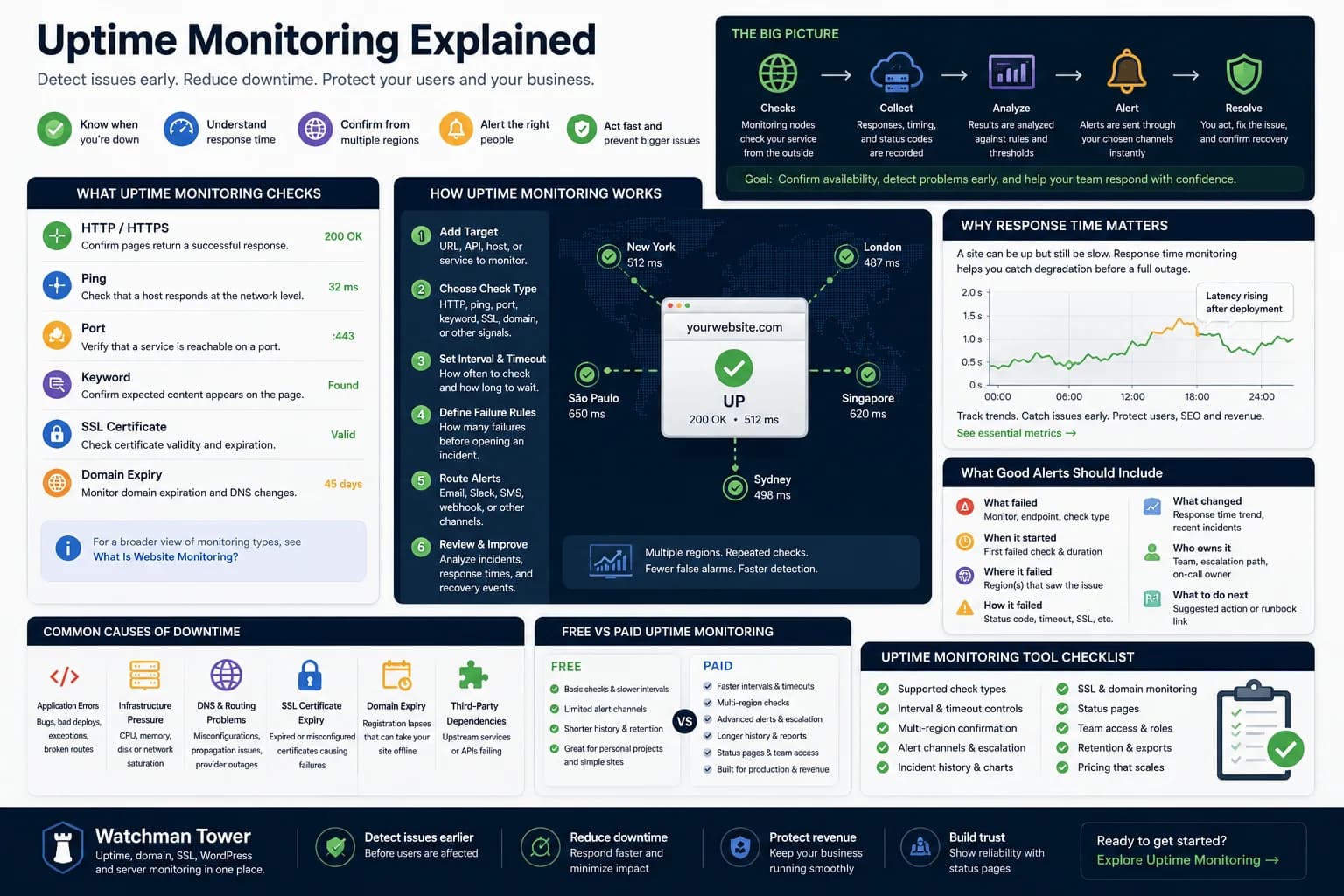
Uptime Monitoring Guide: How to Detect Downtime and Alert Faster...
Uptime monitoring helps you detect when a website, app, or service becomes unavailable. This guide explains how checks work, which signals matter, how alerts should be routed, and how to turn basic uptime checks into a practical response workflow.
Learn more about Uptime Monitoring Guide: How to Detect Downtime and Alert Faster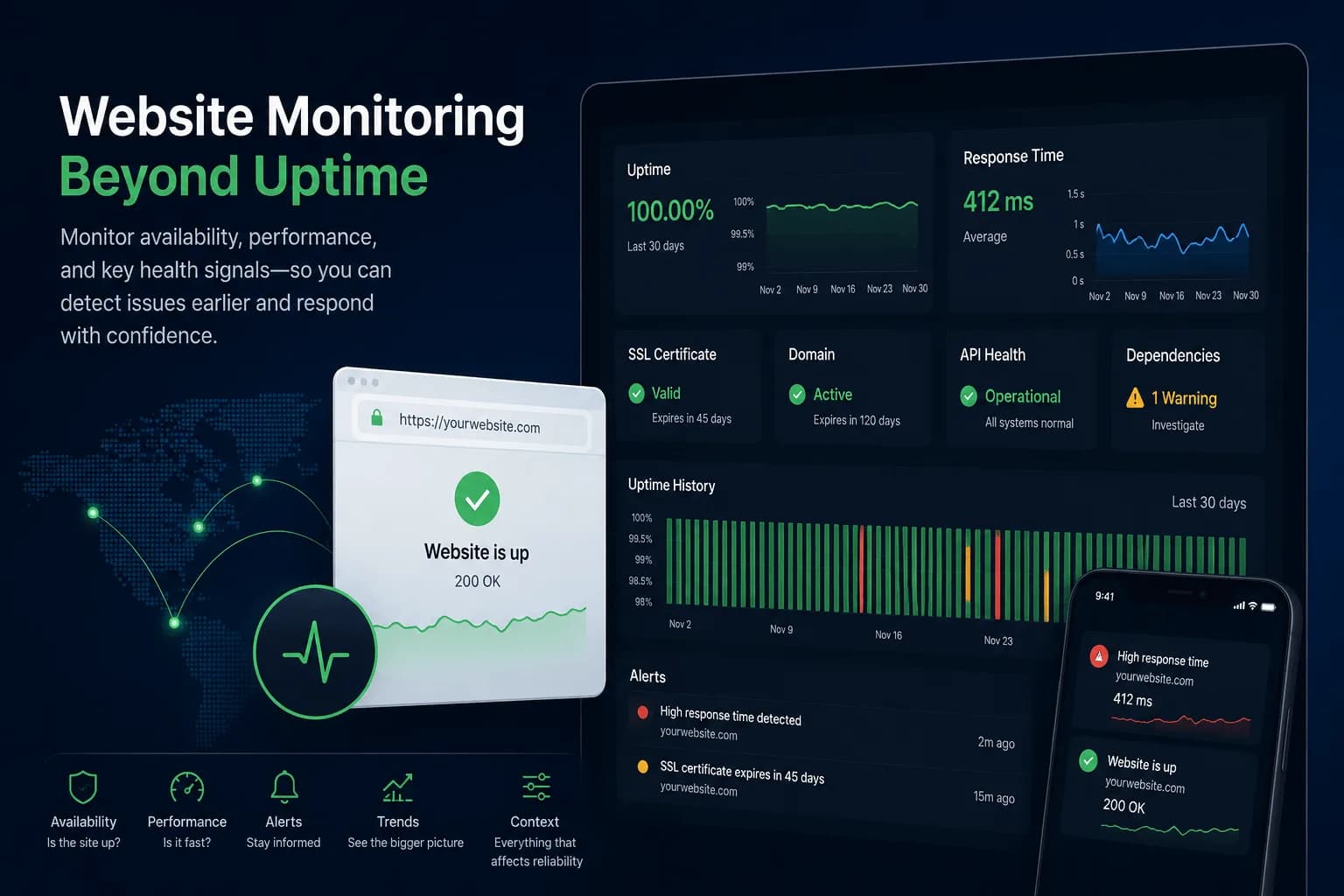
What Is Website Monitoring? How It Works and Why It Matters...
Website monitoring checks whether a site is available, how it performs and whether SSL, domain or dependency risks are building up around it. This guide explains how it works and how it differs from uptime monitoring.
Learn more about What Is Website Monitoring? How It Works and Why It Matters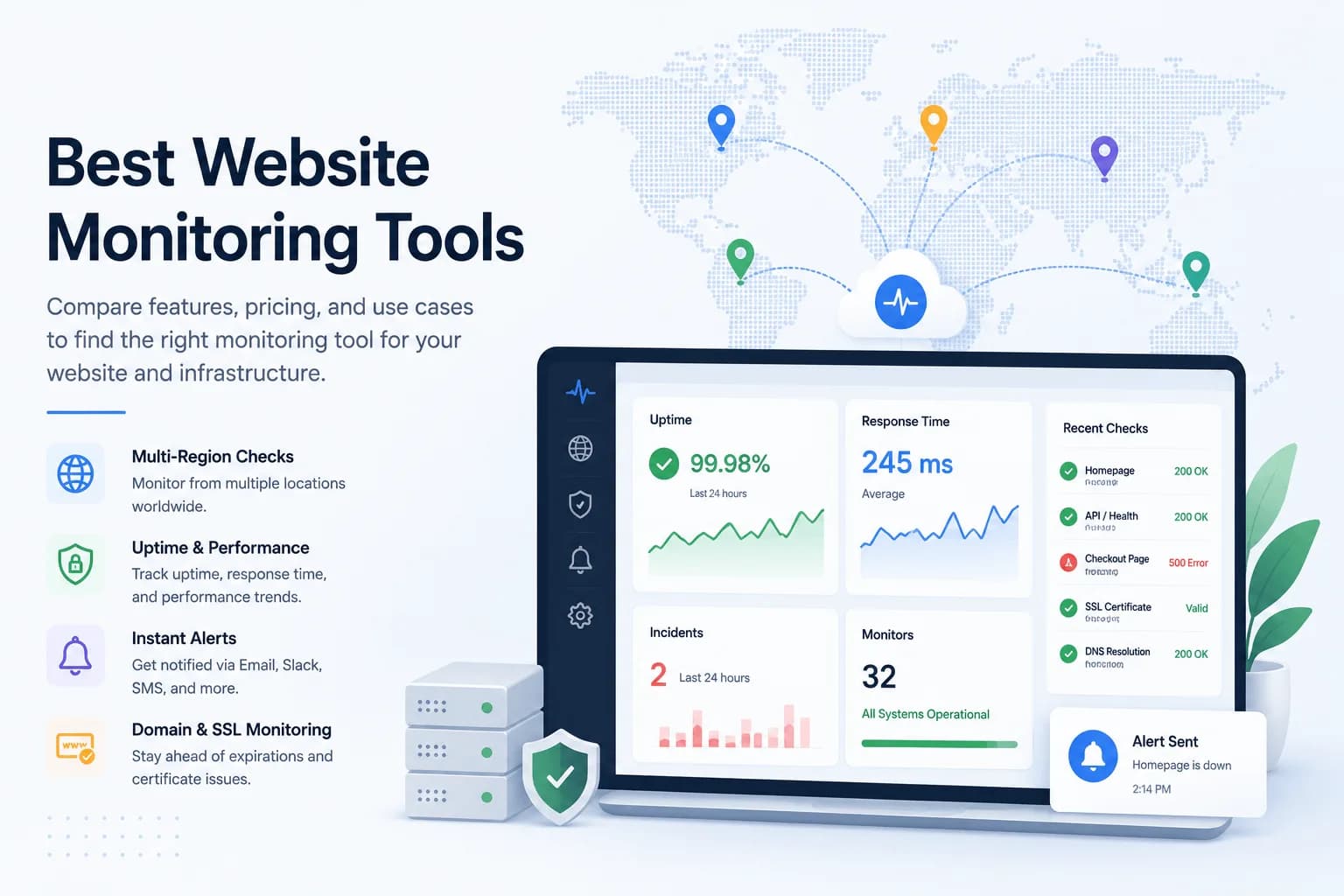
10 Best Website Monitoring Tools in 2026...
The best website monitoring tool depends on what happens after a failed check. This 2026 comparison evaluates five options across uptime coverage, alert quality, status communication, incident workflows, and infrastructure context.
Learn more about 10 Best Website Monitoring Tools in 2026