

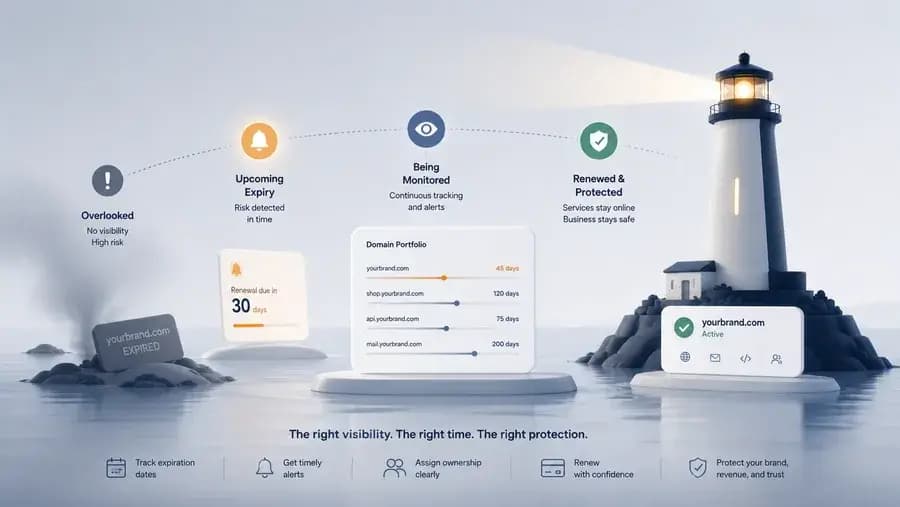
Domain Expiry Monitoring: A Complete Guide to Preventing Domain Loss
- Watchman Tower Team
- Updated: August 23, 2026
- Category: Domain Monitoring
- Read Time: 16 min
Learn what domain expiry monitoring is, why it matters, how it works, and the key practices organizations use to prevent unexpected domain loss. This guide explains the domain expiration lifecycle, monitoring fundamentals, and the principles behind an effective domain renewal strategy.
Domain expiry monitoring is the process of tracking domain expiration dates, renewal status, and related risks before they interrupt a website or business operation. Instead of depending entirely on registrar emails, calendar notes, or personal memory, it creates a structured way to identify upcoming renewals and act before a domain reaches a dangerous stage.
A domain is rarely just a website address. It may be connected to company email, customer portals, APIs, authentication systems, subdomains, marketing campaigns, and third-party integrations. When the domain expires, several of these services can fail at the same time—even when the website infrastructure itself is working normally.
Domain loss usually does not begin with a dramatic technical failure. It starts with ordinary operational problems: an expired payment card, a reminder sent to an inactive employee, unclear ownership, a registrar account nobody checks, or a domain distributed across an unmanaged portfolio. Domain expiry monitoring makes these risks visible early enough to resolve them safely.
This guide explains what domain expiry monitoring is, why it matters, and how it supports a broader domain renewal strategy. It also introduces the main areas that organizations need to consider, including monitoring methods, renewal management, and the tools used to track domain risk at scale.
What Is Domain Expiry Monitoring?
Domain expiry monitoring is the continuous or scheduled tracking of a domain’s registered expiration date. Its purpose is to detect approaching renewal deadlines, notify the responsible people, and confirm that the domain remains active and under the organization’s control.
At the simplest level, monitoring answers one question:
How much time remains before this domain expires?
A reliable monitoring process goes further. It should also help an organization understand:
- Which domains it currently owns or manages
- Which registrar controls each domain
- When every domain is expected to expire
- Whether auto-renewal is enabled
- Who is responsible for completing the renewal
- Which teams should receive upcoming expiry alerts
- Whether the renewal was successfully completed
This distinction is important because knowing an expiry date is not the same as managing expiry risk. A date stored in a spreadsheet has little value if nobody reviews it, the assigned owner has left the company, or the reminder reaches an inbox that is no longer monitored.
Effective monitoring therefore combines expiry data with ownership, notification, and verification. It turns a passive date into an operational signal.
Domain Expiration and Domain Expiry Monitoring Are Not the Same Thing
Domain expiration is an event in the domain lifecycle. It occurs when the registration period ends without a successful renewal.
Domain expiry monitoring is the process used to prevent that event from becoming an unexpected incident.
The difference is similar to the distinction between a deadline and a deadline-management system. The expiration date is fixed by the registrar or registry. Monitoring is the set of checks, alerts, responsibilities, and follow-up actions used to ensure that the deadline is handled correctly.
What Does a Domain Expiry Monitoring System Track?
The main data point is the domain expiration date, usually obtained from registrar records, registry data, or domain registration lookup services. Depending on the implementation, a monitoring system may also track:
- Registrar information
- Registration and renewal dates
- Domain status codes
- Nameserver information
- Auto-renewal status
- Assigned owner or responsible team
- Previous alerts and renewal activity
Not every monitoring setup provides all of this information. A basic system may only calculate the number of days remaining. A more complete setup adds ownership, escalation, notification history, and renewal confirmation so that teams can see not only when a domain expires, but whether the risk is being actively managed.
Why Registrar Reminders Are Not Full Monitoring
Most registrars send renewal emails before a domain expires. These messages are useful, but they represent only one layer of protection.
Registrar reminders are usually tied to a single account, registrar, and contact email. They may be missed because of spam filtering, staff turnover, account changes, or crowded inboxes. They also provide limited visibility when an organization manages domains across several registrars.
Domain expiry monitoring provides an independent view. It brings renewal dates into one system, creates repeated visibility, and reduces the risk of relying on a single registrar notification or one person’s inbox.
Why Domain Expiry Monitoring Matters
An expired domain can affect every service that depends on it. The damage is not limited to a temporarily unavailable homepage. Websites, email delivery, APIs, authentication systems, customer portals, and business integrations may all rely on the same domain.
This makes domain expiry an operational continuity issue rather than a simple administrative oversight.
It Can Take Websites and Services Offline
Once a domain stops resolving correctly, users may no longer be able to reach the website or services hosted beneath it. Subdomains can fail, API endpoints can become unreachable, and applications that depend on domain-based callbacks or authentication may stop functioning.
The servers behind those services may still be healthy. The incident occurs because users and connected systems can no longer reach them through the expected domain.
It Can Disrupt Business Email
Company email often depends on the same domain used by the website. If the domain expires or its DNS configuration is interrupted, incoming and outgoing email may fail.
This can prevent customers from contacting the organization, interrupt password resets and transactional messages, and create confusion among employees and external partners. In some cases, email disruption may be more damaging than website downtime because teams lose a primary communication channel during the incident.
It Can Damage Search Visibility
Search engines expect published pages to remain accessible. If a domain expires and the website becomes unavailable, crawlers may encounter DNS failures, connection problems, or replacement pages.
A brief interruption may be recoverable, but a prolonged outage can weaken search visibility, interrupt crawling, and reduce user confidence. If a third party acquires the domain, the original site may lose control of the URLs and reputation it built over time.
The potential SEO impact is therefore not limited to temporary ranking movement. Domain loss can threaten the continuity of the entire web property.
It Creates Brand and Trust Risks
Customers do not know whether an unavailable domain is caused by a failed renewal, a security incident, or a company that has stopped operating. They only see that the expected website or service no longer works.
This uncertainty can damage trust quickly, particularly for businesses that handle payments, subscriptions, client data, or time-sensitive services.
If the expired domain is acquired by another party, the risk becomes more serious. The new owner may publish unrelated content, redirect visitors elsewhere, or attempt to benefit from the domain’s previous reputation and traffic.
Recovery Can Be Expensive or Impossible
Domain expiration does not always result in immediate permanent loss. Many registrars provide a grace period during which the existing owner can renew the domain. After that, the domain may enter a redemption period with higher recovery fees. For a real-world example of what this looks like in practice, see our case study on how to recover an expired domain after a website went offline and the registrar was unclear.
Once the domain is deleted and becomes available again, recovery is no longer guaranteed. Automated systems, resellers, competitors, or unrelated buyers may register it quickly.
At that point, the original owner may need to negotiate a purchase, use a backordering service, pursue a dispute process, or move the business to another domain. Each option introduces cost, delay, and uncertainty.
Domain Expiry Is Usually an Operational Failure
Most accidental domain losses are not caused by complex infrastructure problems. They result from failures in responsibility, communication, or renewal workflow.
Common causes include:
- An expired or replaced payment card
- Renewal emails sent to an inactive address
- A former employee remaining the only account owner
- Domains distributed across several unmanaged registrar accounts
- Auto-renewal being assumed but never verified
- No clear owner responsible for completing the renewal
Domain expiry monitoring addresses these weaknesses by creating visibility before the renewal deadline becomes an emergency. It gives teams time to update billing information, resolve account access problems, assign responsibility, or investigate unexpected registration data.
The objective is not merely to send another reminder. It is to turn domain renewal into a controlled and verifiable operational process.
How Domain Expiration Happens
Domains do not usually disappear the moment they reach their expiration date. Instead, they move through a series of lifecycle stages defined by the domain registry and the registrar managing the registration.
While the exact timeline varies between top-level domains (TLDs) and registrars, the overall process follows a similar pattern. Understanding these stages helps explain why early monitoring is significantly more valuable than reacting after an expiration has already occurred.
Expiration Date
The lifecycle begins when the domain reaches the end of its current registration period. If the domain has not been renewed successfully, it officially expires.
Expiration does not always mean that services stop immediately. Some registrars continue resolving the domain for a short period, while others suspend DNS services or replace the website with a parking page almost immediately.
Because registrar behavior differs, organizations should never rely on post-expiration grace periods as part of their renewal strategy.
Grace Period
Many registrars provide a grace period after expiration, allowing the current registrant to renew the domain without significant additional cost.
This period acts as a temporary recovery window rather than an extension of the registration itself. During this time, website availability, email delivery, and DNS resolution may already be affected depending on registrar policies.
Monitoring systems should treat the grace period as an exception, not as additional planning time.
Redemption Period
If the domain is not renewed during the grace period, it may enter a redemption phase. At this stage, recovering the domain typically becomes more expensive and requires additional administrative processing.
Although recovery is still possible in many cases, the process is no longer routine. Delays become more costly, and organizations may face unnecessary downtime while ownership is restored.
Deletion and Re-registration
Once the redemption period ends, the domain may be released back to the public registry. At this point, anyone can potentially register it.
Valuable domains are often monitored by automated registration services, domain investors, or organizations looking for previously established web properties. As a result, a lost domain can be claimed within minutes of becoming available.
After this stage, recovering the original domain is no longer guaranteed. It may require purchasing the domain from its new owner, waiting for another expiration cycle, or abandoning the original domain altogether.
Why Monitoring Starts Long Before Expiration
Although most discussions about domain loss focus on what happens after expiration, effective monitoring begins weeks or months before the renewal deadline.
The purpose of monitoring is not to recover expired domains—it is to prevent domains from entering the expiration lifecycle in the first place.
By identifying upcoming renewals early, organizations have time to verify ownership, confirm payment methods, resolve registrar account issues, and complete renewals without operational pressure.
How Domain Expiry Monitoring Works
Domain expiry monitoring combines domain registration data, automated checks, and notification workflows to identify renewal risks before they become service interruptions.
Instead of waiting for registrar reminder emails, a monitoring system continuously evaluates the status of each monitored domain and alerts responsible teams when predefined conditions are met.
Although implementations vary, most monitoring systems follow the same operational workflow.
Collecting Domain Information
The process begins by gathering registration information for every monitored domain. Depending on the monitoring solution, this information may come from registrar APIs, registry services, WHOIS data where available, or internally maintained domain inventories.
The goal is to maintain an accurate view of each domain's registration status without requiring teams to manually check individual registrar accounts.
Tracking Renewal Deadlines
Once registration data is available, the monitoring system continuously calculates the remaining time before expiration.
Rather than generating a single reminder shortly before the deadline, mature monitoring strategies typically create multiple checkpoints throughout the renewal cycle. These checkpoints give organizations enough time to resolve payment issues, ownership questions, or registrar access problems before the renewal becomes urgent.
Generating Alerts
When a renewal milestone approaches, notifications are delivered to the appropriate people or teams.
Modern monitoring platforms often support multiple notification channels such as email, messaging platforms, incident management systems, or collaboration tools. Using more than one communication channel reduces the risk of important reminders being overlooked.
Effective alerting also supports escalation, ensuring that unresolved renewal tasks become visible to additional stakeholders before the expiration date arrives.
Verifying Renewal Success
Sending an alert is only part of the monitoring process. A complete workflow should also verify that the renewal was actually completed successfully.
Payment failures, registrar processing delays, or configuration mistakes can leave a domain approaching expiration even after someone believes the renewal has been handled.
Verification closes this gap by confirming that the expiration date has been extended as expected.
Maintaining Visibility Across the Entire Domain Portfolio
Organizations rarely manage only one domain. Production websites, regional domains, defensive registrations, marketing campaigns, development environments, and customer-facing services often result in dozens or even hundreds of active domains spread across multiple registrars.
Monitoring brings these domains into a single operational view. Instead of tracking individual registrar accounts separately, teams can monitor renewal status, upcoming expirations, ownership responsibilities, and alert history from one centralized process.
This centralized visibility becomes increasingly valuable as organizations grow. It reduces administrative overhead, improves accountability, and lowers the risk that an important domain will be forgotten simply because nobody realized it still required active management.
Building an Effective Domain Expiry Strategy
Successful domain expiry monitoring is not built around a single reminder or one renewal email. It is the result of a structured process that combines visibility, clearly defined responsibilities, and reliable operational practices.
As organizations grow, domain management becomes increasingly complex. Domains may be registered through multiple registrars, owned by different business units, managed by separate IT teams, or renewed using different payment methods. Without a structured strategy, the likelihood of oversight increases with every additional domain.
A complete domain expiry strategy typically consists of three complementary components: monitoring methods, renewal management, and monitoring tools. Each addresses a different aspect of reducing renewal risk.
Monitoring Methods
Monitoring methods define how an organization keeps track of upcoming domain renewals. Some organizations rely on manual calendars or spreadsheets, while others use registrar notifications, centralized asset inventories, or automated monitoring platforms.
The appropriate approach depends on the number of domains being managed, the criticality of those domains, and the level of operational maturity within the organization. What works for a single personal website is rarely sufficient for a business managing dozens or hundreds of domains.
Regardless of the implementation, effective monitoring methods share the same objective: providing enough visibility to identify renewal risks before they become operational incidents.
A detailed comparison of different monitoring approaches—including manual tracking, registrar reminders, and automated monitoring—is covered in our guide to domain expiry monitoring methods.
Domain Renewal Management
Monitoring identifies that a renewal is approaching, but renewal management ensures that the renewal is actually completed.
An effective renewal process defines ownership, verifies payment methods, assigns responsibilities, establishes escalation procedures, and confirms that renewals have been successfully processed. Without these operational controls, monitoring alerts alone cannot prevent domain loss.
Mature organizations treat domain renewal as a repeatable operational workflow rather than a task assigned to a single individual.
Our domain renewal management guide explores the policies, workflows, and organizational practices that reduce renewal risk across an entire domain portfolio.
Domain Expiry Monitoring Tools
Monitoring tools automate much of the work involved in tracking domain expiration. Instead of manually checking registrar accounts or maintaining spreadsheets, organizations can continuously monitor renewal dates, receive alerts, and maintain visibility across all managed domains from a centralized system.
Different tools focus on different needs. Some provide basic reminder functionality, while others include portfolio management, multi-channel notifications, reporting, integrations, and operational dashboards designed for larger environments.
Choosing the right solution depends on factors such as portfolio size, operational requirements, notification preferences, and existing infrastructure.
Our guide to domain expiry monitoring tools compares the available approaches and explains which types of solutions are appropriate for different organizations.
Common Mistakes That Lead to Domain Loss
Most domain expiration incidents are preventable. They rarely occur because organizations are unaware that domains eventually expire. Instead, they happen because routine renewal processes quietly fail over time.
Several patterns appear repeatedly across organizations that experience unexpected domain loss.
Assuming Auto-Renew Is Enough
Auto-renew reduces administrative effort, but it should never be treated as a guarantee. Failed payment methods, registrar account issues, or billing problems can prevent automatic renewals from completing successfully.
Monitoring should confirm that the renewal actually occurred rather than assuming automation always succeeds.
Relying on a Single Email Address
Renewal notifications sent to one mailbox create a single point of failure. If that inbox becomes inactive, inaccessible, or simply overlooked, important renewal notices may never reach the people responsible for taking action.
Critical domain assets should remain visible through multiple notification channels and shared operational ownership.
No Clear Ownership
Domains often outlive the employees who originally registered them. Without clearly assigned ownership, teams may assume someone else is responsible for renewals, leaving important assets unmanaged until an expiration notice appears.
Every production domain should have an identified owner and a documented renewal process.
Managing Domains Across Multiple Registrars Without Central Visibility
As organizations grow, domains frequently become distributed across several registrar accounts created over many years. This fragmentation makes it increasingly difficult to understand which domains exist, who owns them, and when each one requires renewal.
Centralized monitoring provides a consolidated view of the entire domain portfolio, reducing the risk that important domains are overlooked simply because they are managed somewhere else.
Treating Renewal as a Once-a-Year Task
Domain renewal is often viewed as an annual administrative activity. In reality, it is an ongoing operational responsibility that benefits from continuous visibility throughout the year.
Organizations that monitor domains continuously have significantly more time to resolve ownership questions, billing problems, and registrar access issues before those problems become business disruptions.
Conclusion
Domain expiry monitoring is not simply about remembering renewal dates. It is about reducing operational risk by making domain ownership, renewal responsibilities, and upcoming deadlines continuously visible.
While a single domain may seem easy to manage, complexity increases quickly as organizations grow. Multiple registrars, distributed teams, changing payment methods, and expanding domain portfolios create opportunities for small administrative issues to become costly business incidents.
A structured monitoring strategy helps eliminate these blind spots. Instead of relying on individual reminders or assumptions that auto-renew will always succeed, organizations gain a repeatable process for identifying risks, verifying renewals, and maintaining control over their domain portfolio.
Building that strategy involves more than choosing a monitoring platform. It requires selecting appropriate monitoring methods, establishing reliable renewal workflows, and using tools that provide visibility across all critical domains.
Free plan available. No credit card needed.
Want a Dedicated Expiry Monitoring Tool?
Don’t rely only on registrar emails. Watchman Tower gives you automatic expiry alerts across all registrars, with reminders at 30, 14, 7, and 1 day before expiry.
Learn more about Domain Expiry Monitoring →FAQ
What happens immediately when a domain expires?v
What are the most common reasons domains actually get lost?v
Why aren't registrar email alerts enough to prevent domain loss?v
What are the key steps for a safer domain expiry monitoring setup?v
What should I do if my domain has already expired?v
Blog Posts
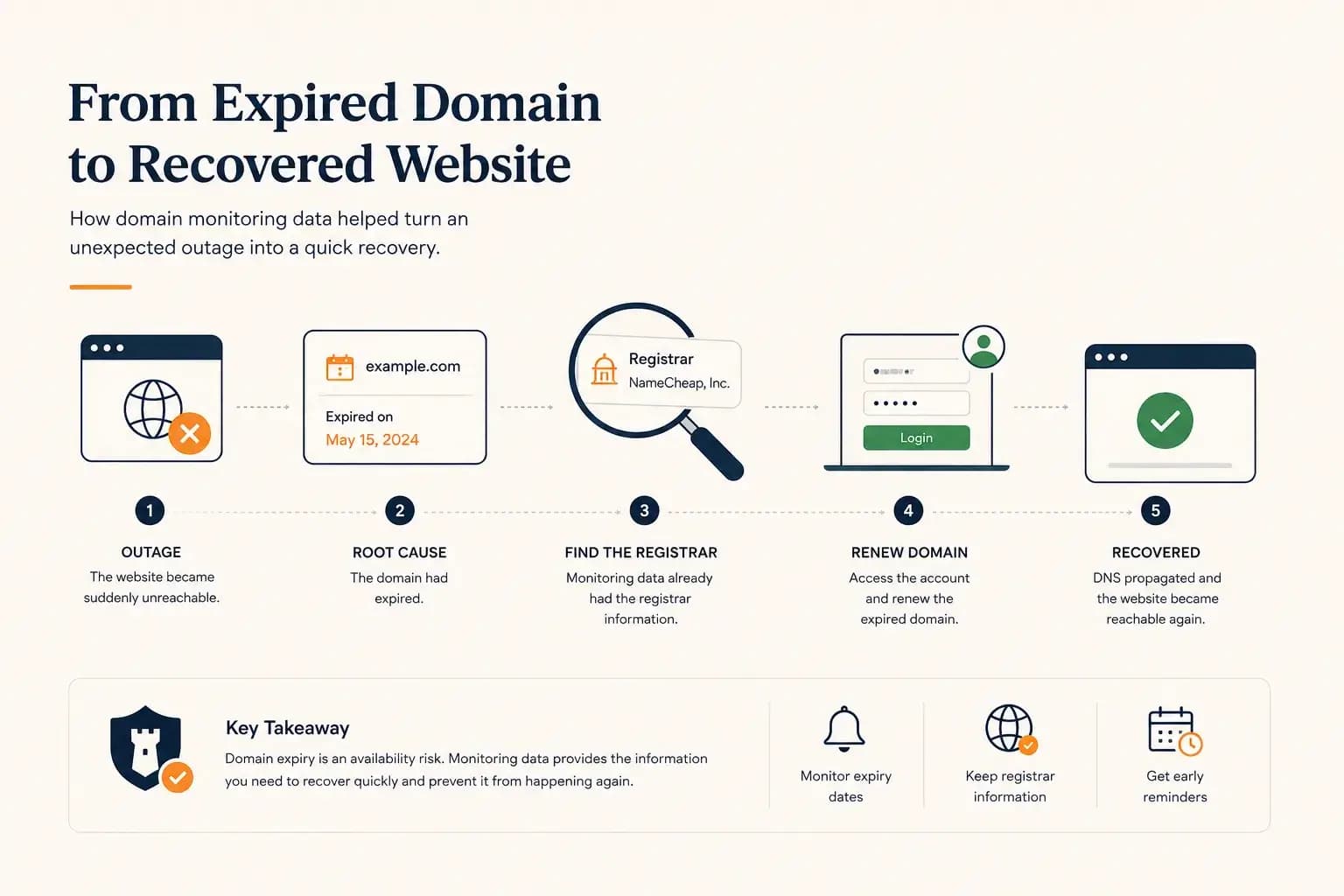
The Website Went Down — and the Owner Didn’t Know Where the Domain Was Registered...
A real-world expired domain recovery case: how a website went offline, how we identified the registrar from monitoring data, and how the domain was renewed before it was lost.
Learn more about The Website Went Down — and the Owner Didn’t Know Where the Domain Was Registered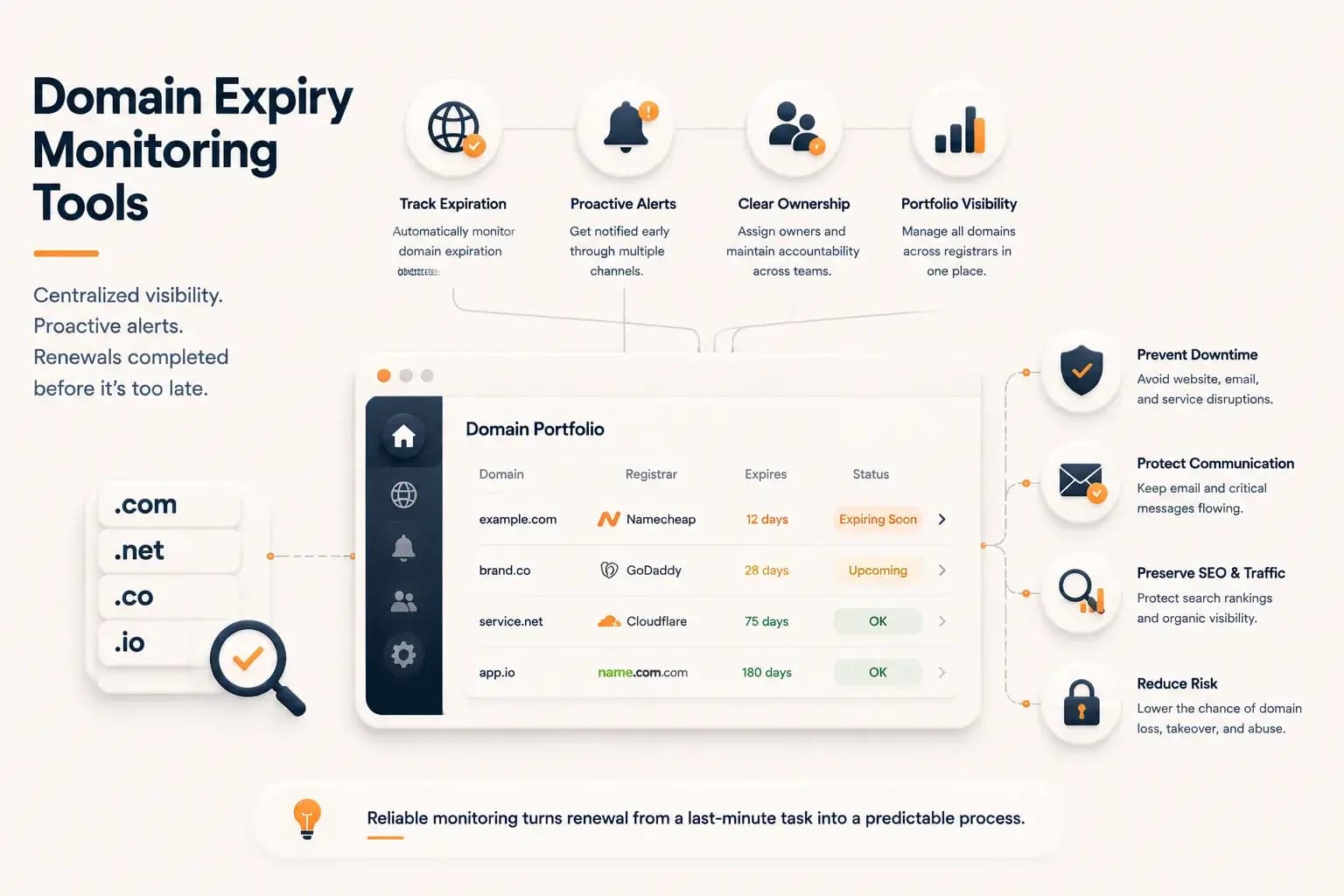
Best Domain Expiry Monitoring Tools: How to Choose the Right Solution...
Explore how domain expiry monitoring tools help organizations track renewal risks, manage multiple domains, and choose the right solution based on visibility, automation, and operational needs.
Learn more about Best Domain Expiry Monitoring Tools: How to Choose the Right Solution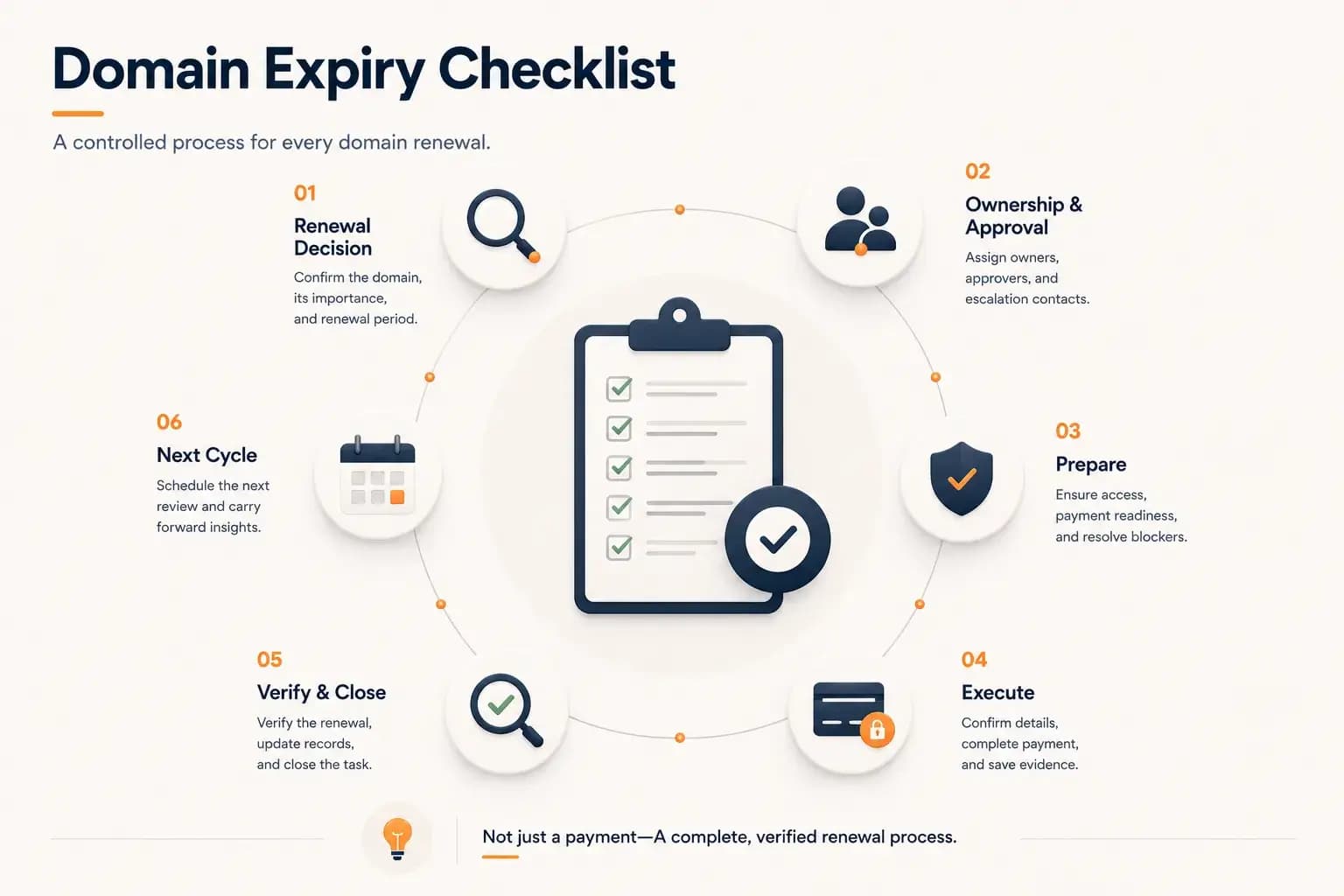
Domain Expiry Checklist: A Complete Renewal Process...
Follow a practical domain expiry checklist that standardizes every stage of the renewal process, from planning and ownership to execution, verification, documentation, and preparing the next renewal cycle. Learn how to reduce operational risk with a repeatable renewal workflow.
Learn more about Domain Expiry Checklist: A Complete Renewal Process