

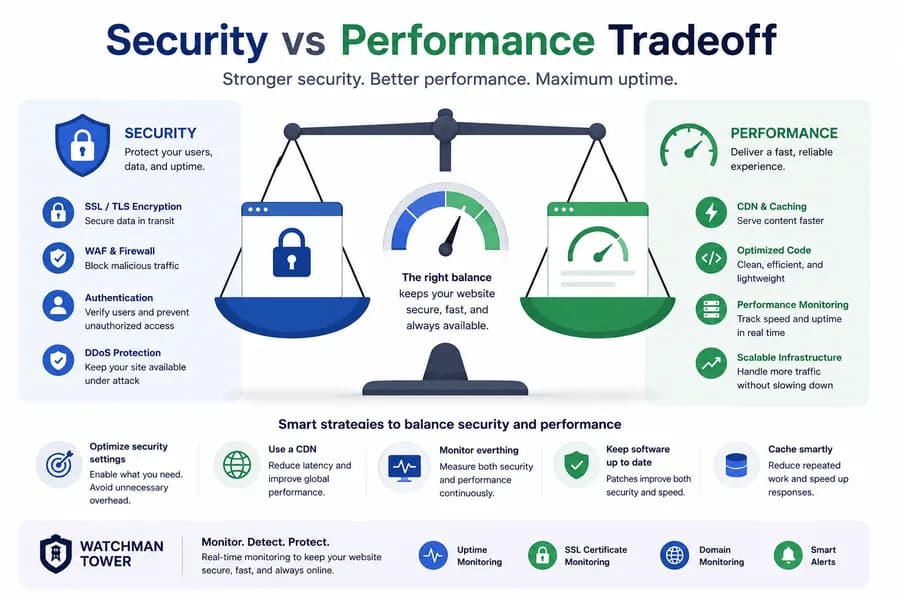
Security vs Performance Tradeoff: How to Improve Security Without Slowing Down Your Website
- Watchman Tower Team
- Updated: July 21, 2026
- Category: Security Monitoring
- Read Time: 4 min
Security and performance often feel like opposing forces, but monitoring helps teams see where that tradeoff is real and where it is simply unmanaged visibility.
Website owners often face the same question:
Can I improve security without hurting performance?
The answer is yes—but only if you understand where security introduces overhead and where it actually improves reliability.
The real challenge isn't choosing between security and speed. It's finding the right balance between protection, performance, and uptime.
What Is the Security vs Performance Tradeoff?
The security vs performance tradeoff describes the additional work a system performs to protect itself.
Security controls consume resources.
They inspect requests, encrypt traffic, validate users, or filter malicious activity. Every one of those operations adds some overhead.
The important question isn't:
"Does security slow down my website?"
It's:
"Which security controls provide meaningful protection without creating unnecessary latency?"
Why Security Still Comes First
Removing security to gain a few milliseconds is almost never worth the risk.
A successful attack can cause:
- Complete website downtime
- Data breaches
- Customer trust loss
- SEO damage
- Revenue loss
- Expensive incident recovery
In other words, the fastest website in the world provides no value if attackers can take it offline.
Security protects availability just as much as it protects data.
Where Security Can Affect Performance
Not every security layer has the same impact.
Common examples include:
TLS / HTTPS Encryption
Modern TLS is highly optimized, but encryption still requires CPU resources during connection establishment.
Fortunately, HTTP/2, HTTP/3, session resumption, and modern hardware have made this overhead very small.
Web Application Firewalls (WAF)
A WAF analyzes incoming requests before they reach your application.
Poorly configured rules can introduce additional latency, especially when every request is deeply inspected.
The solution isn't removing the firewall—it's optimizing the rule set.
DDoS Protection
Traffic filtering inevitably adds another processing layer.
However, that small delay is insignificant compared to the downtime caused by an actual attack.
Authentication & Authorization
Multiple authentication checks, token validation, and permission lookups all consume time.
Caching authorization data where appropriate can dramatically reduce their impact.
Performance Problems Aren't Always Caused by Security
One of the biggest misconceptions is blaming security for every slowdown.
In reality, performance issues are more commonly caused by:
- Slow database queries
- Inefficient application code
- Large JavaScript bundles
- Poor caching
- Third-party services
- High server load
Security often receives the blame simply because it sits in front of the application.
Monitoring helps determine the real cause.
Monitor Both Security and Performance
Security and performance should never be measured separately.
A healthy monitoring strategy includes:
- Uptime monitoring
- Response time tracking
- SSL certificate monitoring
- Domain monitoring
- Performance trend analysis
- Incident history
Watching these signals together makes it much easier to identify whether a slowdown comes from infrastructure, application behavior, or a security layer.
Best Practices for Balancing Security and Performance
Instead of choosing one over the other, optimize both.
Use HTTPS Everywhere
Modern TLS has very little overhead and provides enormous security benefits.
Optimize Your WAF
Enable the protections you actually need.
Avoid unnecessarily complex rule sets that inspect every request equally.
Use a CDN
A Content Delivery Network can improve both security and speed by:
- caching static assets
- reducing latency
- absorbing DDoS traffic
- terminating TLS closer to users
Keep Software Updated
Old software creates security risks and often performs worse than modern versions.
Keeping servers, frameworks, and libraries current benefits both security and performance.
Monitor Before You Optimize
Never assume security is causing performance issues.
Measure first.
Real monitoring data prevents expensive guesswork.
How Watchman Tower Helps
Watchman Tower helps teams understand both availability and performance from the user's perspective.
Instead of only collecting infrastructure metrics, it continuously monitors:
- Website uptime
- Response time
- SSL certificate health
- Domain expiration
- Incident history
- Alert notifications
This makes it easier to spot whether changes in performance correlate with deployments, infrastructure issues, or security-related events.
Rather than forcing teams to choose between security and speed, Watchman Tower helps them maintain both.
Final Thoughts
The security vs performance tradeoff is real—but it is often misunderstood.
Good security does introduce some overhead.
Good engineering minimizes that overhead.
The goal isn't to build the fastest possible website or the most heavily protected one.
The goal is to build a website that stays fast, secure, and available under real-world conditions.
The best teams don't optimize security instead of performance.
They monitor both continuously and improve them together.
Free plan available. No credit card needed.
FAQ
What is the security-performance paradox?v
Why is security essential for website uptime?v
How do security measures impact website performance?v
What strategies help balance security and performance?v
How do e-commerce platforms balance security and performance?v
Are performance issues always caused by security measures?v
Does HTTPS significantly slow down my website?v
How can a CDN help with both security and performance?v
Blog Posts
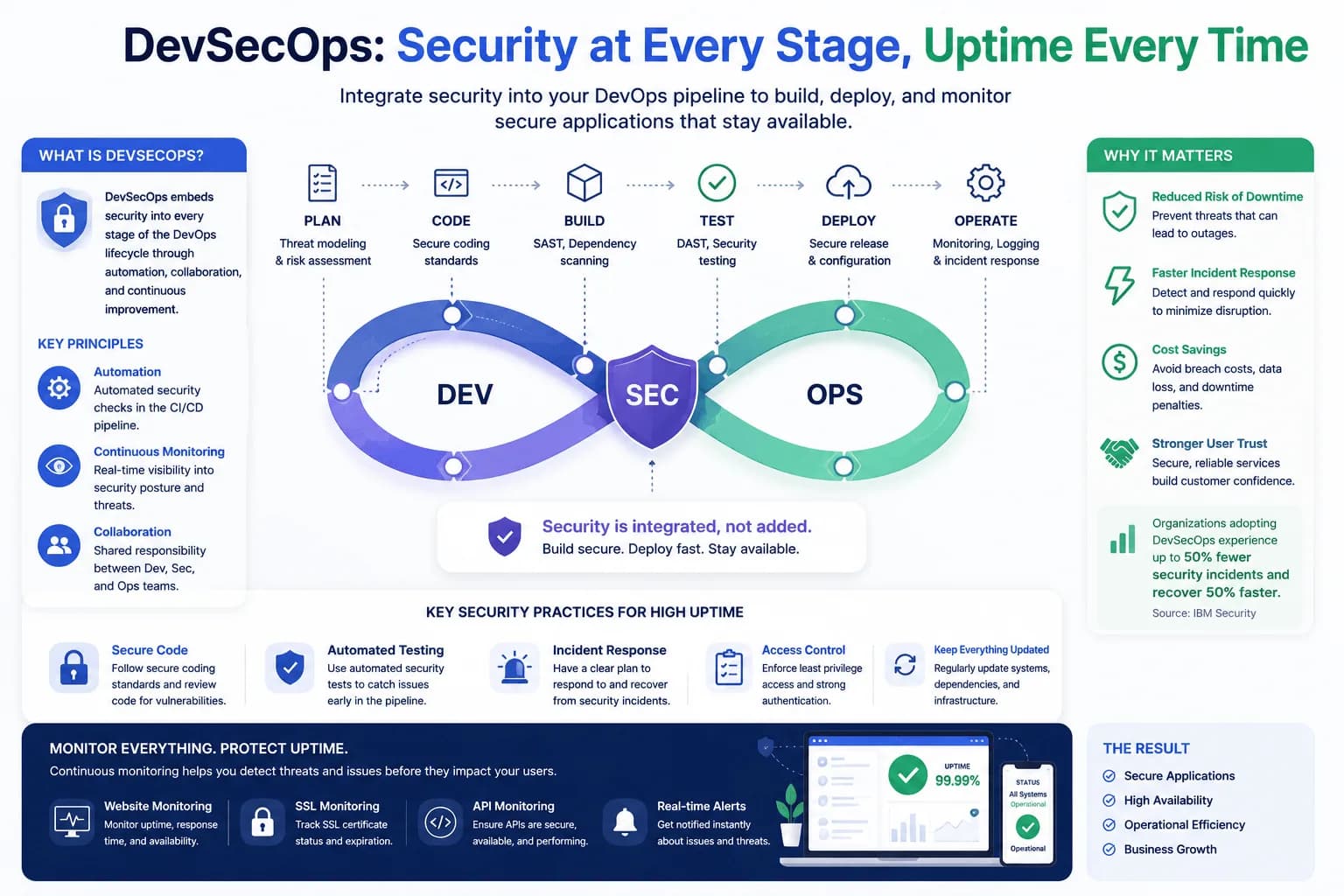
DevSecOps: Integrating Security Into Your Uptime Strategy...
DevSecOps becomes more useful when security joins uptime and reliability as part of one visibility workflow. This guide explores that connection.
Learn more about DevSecOps: Integrating Security Into Your Uptime Strategy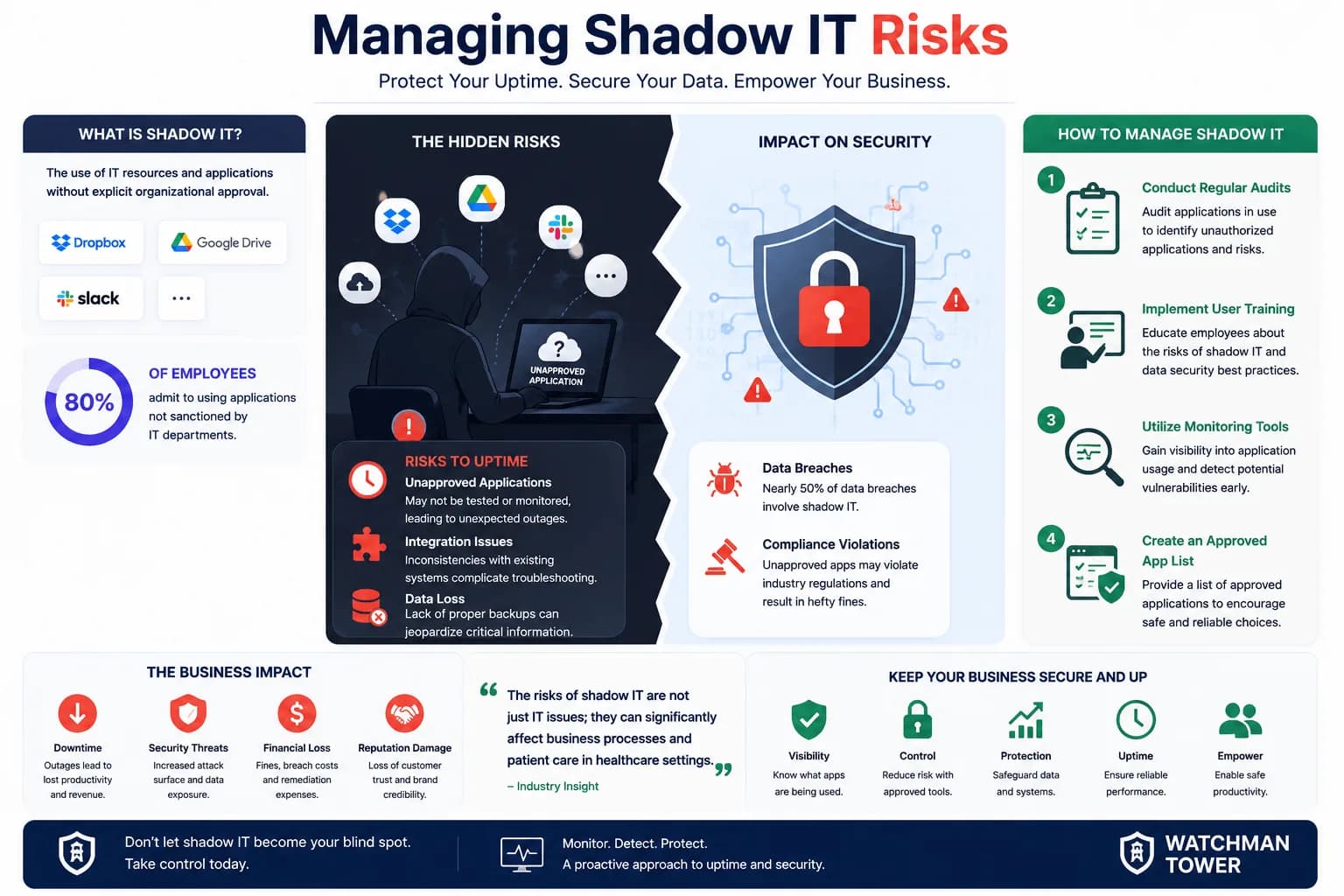
The Impact of Shadow IT on Uptime and Security: What You Need to Know...
Shadow IT creates uptime and security risk because it breaks visibility. This guide explains why operational health depends on seeing more of the real system surface.
Learn more about The Impact of Shadow IT on Uptime and Security: What You Need to Know
Security Monitoring for Websites: What to Watch and How to React...
Security monitoring is really about earlier risk visibility. This guide explains what teams should watch and how security-related signals fit into broader operational monitoring.
Learn more about Security Monitoring for Websites: What to Watch and How to React