

Domain Expiry Monitoring Methods: Free and Automated Options Compared
- Watchman Tower Team
- Updated: September 1, 2026
- Category: Domain Monitoring
- Read Time: 13 min
Free and paid domain monitoring methods solve different levels of risk. This guide explains where free reminders help and where teams need stronger continuity visibility.
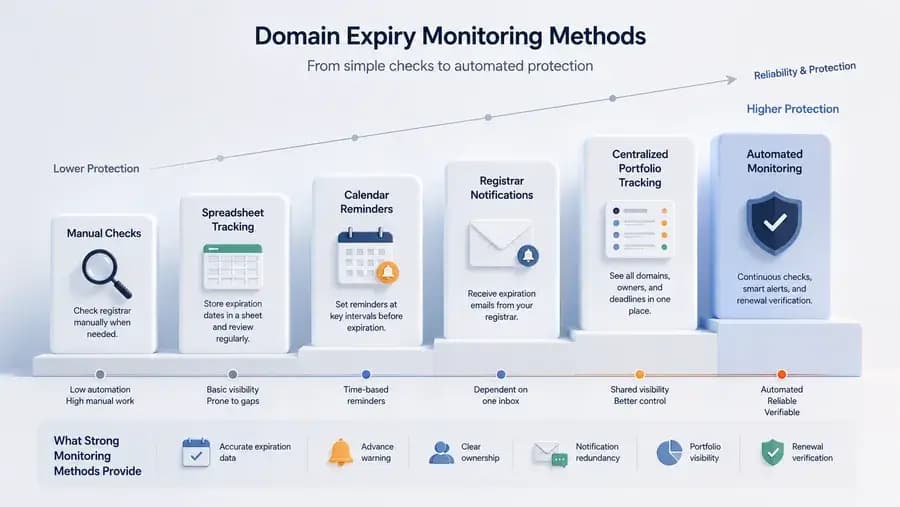
There are several ways to monitor domain expiration, ranging from simple calendar reminders to domain expiry monitoring tools that continuously track renewal dates. Each method offers a different level of reliability, visibility, and operational control.
The right approach depends on more than the number of domains being managed. A single business-critical domain may require stronger safeguards than a large portfolio of low-risk domains. Team structure, registrar diversity, notification ownership, and the consequences of a missed renewal should all influence the monitoring method.
This guide compares the main domain expiry monitoring methods, explains where each approach works well, and helps you determine when a more structured or automated system becomes necessary.
What Makes a Domain Expiry Monitoring Method Reliable?
A domain expiry monitoring method should do more than record an expiration date. It should help ensure that the correct people receive reliable information early enough to take action.
The strongest monitoring methods typically provide several forms of protection:
- Accurate expiration data: The system should use current domain information rather than relying permanently on a date that was entered manually.
- Advance warning: Alerts should begin early enough to resolve payment, ownership, or registrar access problems before the renewal deadline.
- Clear ownership: The organization should know who is responsible for reviewing alerts and completing the renewal.
- Notification redundancy: A single inbox, employee, or communication channel should not be the only source of warning.
- Portfolio visibility: Teams managing multiple domains should be able to see renewal risk across the entire portfolio.
- Renewal verification: A renewal should be confirmed rather than assumed to have succeeded.
No monitoring method is equally strong in all of these areas. Manual approaches may be sufficient for small, low-risk portfolios, while larger organizations usually need centralized and automated controls.
Manual Domain Expiry Checks
Manual checking is the most basic domain expiry monitoring method. A domain owner periodically opens the registrar account, performs a domain lookup, or reviews domain registration records to confirm the expiration date.
This approach requires no specialized software and can work when only one or two domains are involved. It is also useful as a verification step when a renewal date appears incorrect or when the owner wants to confirm that a recent renewal has been processed.
Advantages of Manual Checks
- No additional monitoring cost
- Easy to perform for a very small number of domains
- Useful for confirming registrar or monitoring data
- Does not require a separate platform
Limitations of Manual Checks
- Depends entirely on someone remembering to perform the check
- Provides no automatic warning when a renewal date approaches
- Becomes difficult to manage as the portfolio grows
- May be skipped during busy periods, staff changes, or operational disruptions
- Does not provide shared visibility unless results are recorded elsewhere
Manual checking is better treated as a supporting control than as the primary monitoring method for an important domain. It can confirm information, but it does not create a dependable warning system on its own. Manual domain expiry checks are better treated as a supporting control than as the primary monitoring method for an important domain.
Spreadsheet-Based Domain Tracking
A spreadsheet provides a central inventory of domains and their renewal information. It is often the first structured method adopted when an individual or organization begins managing multiple domains.
A useful domain tracking spreadsheet may contain fields such as:
- Domain name
- Registrar
- Expiration date
- Account owner
- Operational owner
- Auto-renew status
- Payment method status
- Renewal cost
- Reminder dates
- Notes about access or ownership
The main strength of a spreadsheet is visibility. Instead of checking several registrar dashboards independently, the organization gains one place to review its domain portfolio.
Advantages of Spreadsheet Tracking
- Low cost and easy to set up
- Creates a centralized domain inventory
- Can include ownership and operational notes
- Works with domains registered through different providers
- Can be shared across a small team
Limitations of Spreadsheet Tracking
- Expiration dates can become outdated
- Data depends on manual entry and maintenance
- The spreadsheet does not automatically detect changes
- Alerts must be created through another system
- Renewals may be completed without the spreadsheet being updated
- Multiple copies can create conflicting information
A spreadsheet is an inventory, not a complete monitoring system. It helps teams understand what they own, but it does not independently confirm whether the recorded dates remain accurate.
This distinction becomes important when domains are renewed for different periods, transferred between registrars, or managed by several departments. Unless the spreadsheet is regularly reviewed, its data can gradually become unreliable.
Calendar and Task-Based Reminders
Calendar reminders and recurring tasks are a simple way to turn an expiration date into an actionable deadline. A domain owner may create several reminders, such as 90, 60, 30, and 7 days before expiration.
This method improves on manual checking because it does not require the owner to remember the date without assistance. It is commonly used alongside a spreadsheet or registrar notifications.
Advantages of Calendar Reminders
- Simple to configure
- Available through tools most teams already use
- Can assign reminders to specific people
- Supports multiple warning intervals
- Can be combined with renewal tasks and approval workflows
Limitations of Calendar Reminders
- The reminder date does not update automatically if the domain date changes
- A completed reminder does not prove that the domain was renewed
- Reminders may remain assigned to employees who have left the organization
- Calendar events can be dismissed without action
- Managing many domains produces a large number of manual tasks
Calendar-based monitoring works best when the domain data is stable and the portfolio is small. It becomes less dependable when renewal dates change frequently or when responsibility is distributed across a larger team.
Registrar Expiry Notifications
Most registrars send email notifications before a domain expires. These messages may begin several weeks or months before the renewal deadline and continue as the expiration date approaches.
Registrar notifications are useful because they come from the provider responsible for the domain registration. They often reflect the registrar’s current account and billing information.
However, registrar notifications should not be treated as an independent monitoring system. They are one warning source within the same account and organization responsible for processing the renewal. Additionally, recognizing common domain expiration warning signs early can help organizations avoid these risks.
Advantages of Registrar Notifications
- Usually included with domain registration
- Based on registrar account information
- Requires little or no additional setup
- May include payment or auto-renew failure notices
- Can provide several reminders before expiration
Limitations of Registrar Notifications
- Messages may be delivered to an outdated email address
- Notifications can be filtered into spam or ignored
- The account may depend on one former employee or external contractor
- Different registrars use different notification schedules
- Email delivery does not guarantee that someone acted on the warning
- A compromised registrar account may affect both renewal and notification access
The main risk is concentration. If domain ownership, billing, and alerts all depend on the same registrar account and email address, one access problem can affect the entire renewal process.
Registrar notifications are valuable, but important domains should also be tracked through a method that is operationally independent of the registrar.
Centralized Domain Portfolio Tracking
Centralized portfolio tracking brings domains from multiple registrars into one operational view, simplifying domain renewal management. It may be implemented through a dedicated domain management platform, an internal asset system, or another shared source of truth.
This approach becomes valuable when an organization owns domains across several brands, products, departments, countries, or registrar accounts.
The purpose is not only to see expiration dates. A centralized portfolio should also clarify:
- Who owns each domain
- Who is responsible for renewal
- Which registrar controls the registration
- Whether auto-renew is enabled
- Which payment method is being used
- Which domains are operationally critical
- Whether renewal has been completed and verified
Advantages of Centralized Portfolio Tracking
- Creates visibility across multiple registrars
- Reduces dependence on individual account holders
- Supports shared ownership and reporting
- Makes it easier to identify high-risk domains
- Provides a foundation for standardized renewal processes
Limitations of Centralized Portfolio Tracking
- Requires ongoing data governance
- May still depend on manual updates
- Does not automatically guarantee alert delivery
- Can become another outdated inventory if it is not connected to current domain data
Centralization solves the visibility problem, but it does not automatically solve the monitoring problem. The strongest implementations combine portfolio visibility with current domain checks and reliable alerts.
Automated Domain Expiry Monitoring
Automated domain expiry monitoring systems check domain information on a recurring schedule and notify users when an expiration date enters a defined warning period.
Instead of depending on a manually maintained date, an automated system periodically collects current domain data. This reduces the risk that reminders continue using an old expiration date after a renewal, transfer, or registration change.
Depending on the system, automated monitoring may provide:
- Scheduled expiration-date checks
- Alerts at configurable intervals
- Monitoring across multiple registrars
- Shared access for teams
- Multiple notification channels
- Portfolio-level reporting
- Renewal status verification
- Escalation when alerts are not acknowledged
Advantages of Automated Monitoring
- Reduces dependence on manual data entry
- Scales more effectively across larger portfolios
- Can provide earlier and repeated warnings
- Creates visibility independent of the registrar interface
- Supports shared operational responsibility
- Can detect whether an expiration date changed after renewal
Limitations of Automated Monitoring
- May require configuration and ongoing administration
- Some domain registration data may be incomplete or restricted
- Alert rules must be designed carefully to avoid notification fatigue
- The monitoring system itself must be maintained
- Automation does not replace clear renewal ownership
Automation improves reliability, but it does not remove the need for process. An alert is only useful when someone is responsible for reviewing it, resolving the underlying issue, and confirming the renewal.
Free vs Paid Domain Expiry Monitoring Methods
Domain expiry monitoring methods are often described as either free or paid, but cost alone is not the most useful distinction. The more important differences are independence, reliability, scalability, and the amount of manual work required.
Free methods can provide adequate protection for a small number of low-risk domains. Paid or automated systems become more valuable as the number, importance, or organizational complexity of the domains increases.
| Method | Typical Cost | Automation | Scalability | Renewal Verification |
|---|---|---|---|---|
| Manual checks | Free | None | Low | Manual |
| Spreadsheet tracking | Free or low cost | Limited | Low to medium | Manual |
| Calendar or task reminders | Usually free | Reminder automation only | Low to medium | Manual |
| Registrar notifications | Usually included | Automatic alerts | Medium | Limited |
| Centralized portfolio tracking | Free or paid | Varies | Medium to high | Varies |
| Automated expiry monitoring | Free or paid | High | High | Often available |
A free method is not necessarily unreliable, and a paid system is not automatically sufficient. A carefully maintained calendar process may protect a small portfolio effectively, while an expensive platform can still fail if alerts are ignored or ownership is unclear.
The appropriate investment should be based on the potential impact of domain loss, not simply the number of domains being monitored.
Choosing a Monitoring Method by Portfolio Size
Portfolio size provides a useful starting point, but it should not be the only selection criterion. Domain criticality, team structure, and registrar complexity can justify stronger monitoring even when only a few domains are involved.
Monitoring 1–5 Domains
A small portfolio can often be managed with a combination of registrar alerts, calendar reminders, and periodic manual verification.
At minimum, each domain should have:
- A current registrar contact address
- More than one renewal reminder
- A confirmed responsible owner
- A valid payment method
- A manual check after renewal
Even at this size, independent monitoring may be appropriate when one domain controls the organization’s website, email, customer portal, or another critical service.
Monitoring 5–25 Domains
As the portfolio grows, informal reminders become more difficult to maintain. A centralized inventory and independent alerting system become increasingly valuable.
Recommended controls include:
- A shared portfolio record
- Named ownership for every domain
- Multiple alert intervals
- Independent expiry monitoring
- Regular reviews of auto-renew and payment status
- A process for recording completed renewals
Monitoring More Than 25 Domains
Larger portfolios usually require automation, standardized ownership, and portfolio-level reporting. Manual reminders alone create too many opportunities for inconsistent data and missed responsibilities.
Organizations at this level should consider:
- Automated recurring checks
- Centralized visibility across registrars
- Shared or role-based notification ownership
- Escalation rules for unresolved alerts
- Renewal verification
- Periodic portfolio audits
- Classification of domains by business criticality
The same controls may also be appropriate for smaller portfolios containing highly valuable or operationally sensitive domains.
Why Combining Multiple Methods Is Safer
No single monitoring method protects against every type of failure. Registrar notifications can fail because of an outdated email address. Calendar reminders can become inaccurate. Spreadsheets can be forgotten. Automated systems can generate alerts that nobody owns.
A layered approach reduces dependence on any one system or person.
A practical monitoring structure may combine:
- Auto-renew enabled at the registrar
- Registrar email notifications
- Independent expiration monitoring
- A centralized domain inventory
- A named renewal owner
- Verification after the renewal date changes
These controls protect against different risks. Auto-renew handles routine renewal attempts. Registrar messages provide account-level warnings. Independent monitoring creates an external source of visibility. Ownership ensures that alerts lead to action.
The goal is not to create unnecessary complexity. It is to prevent one missed email, failed payment, or ownership change from becoming a domain expiration incident.
Common Mistakes When Choosing a Monitoring Method
Choosing Only by Cost
Free monitoring may be sufficient for low-risk domains, but cost should be compared with the operational and financial consequences of expiration. A method that saves a small subscription fee may create much larger recovery costs if it fails.
Assuming Auto-Renew Is Monitoring
Auto-renew is a renewal mechanism, not a monitoring method. It may fail because of an expired payment card, account restriction, billing error, or registrar problem. Monitoring should confirm that the expected renewal actually occurred.
Depending on One Email Address
Alerts sent to a single inbox create a fragile dependency. The address may become inactive, access may be lost, or messages may be overlooked. Important domains should have shared or redundant notification ownership.
Using Static Dates Without Verification
Dates stored in spreadsheets and calendars can become inaccurate after a renewal or transfer. Any static tracking method should be reviewed against current domain information.
Using the Same Method for Every Domain
Not every domain has the same business importance. A parked defensive domain and a primary customer-facing domain should not necessarily receive the same monitoring controls.
Generating Alerts Without Assigning Responsibility
More notifications do not automatically reduce risk. Every alert should have a clear recipient, expected action, and escalation path when the issue remains unresolved.
Conclusion
Domain expiry monitoring can be handled through manual checks, spreadsheets, calendar reminders, registrar notifications, centralized inventories, or automated monitoring systems. Each method provides a different balance of simplicity, reliability, and scalability.
Manual and free methods may be adequate for a small portfolio, especially when domain ownership is clear and the potential impact of expiration is limited. As the number or importance of domains increases, organizations need stronger visibility, independent alerts, and more reliable renewal verification.
The safest approach is usually not to depend on one method alone. Combining registrar controls, independent monitoring, clear ownership, and renewal verification creates a more resilient process and reduces the chance that a routine administrative oversight leads to domain loss.
Free plan available. No credit card needed.
Want a Dedicated Expiry Monitoring Tool?
Don’t rely only on registrar emails. Watchman Tower gives you automatic expiry alerts across all registrars, with reminders at 30, 14, 7, and 1 day before expiry.
Learn more about Domain Expiry Monitoring →FAQ
Why is domain expiration monitoring important?v
What happens after a domain expires?v
What are quick ways to check a domain's expiry?v
What's the difference between free and paid domain expiration monitoring?v
How should I set up domain expiration alerts?v
What are common domain expiration pitfalls to avoid?v
Why is monitoring domain expiration important?v
What happens after a domain expires?v
How can I check a domain's expiration date?v
What's the difference between free and paid domain monitoring tools?v
What are best practices for domain expiration monitoring?v
What common domain expiration mistakes should I avoid?v
Blog Posts
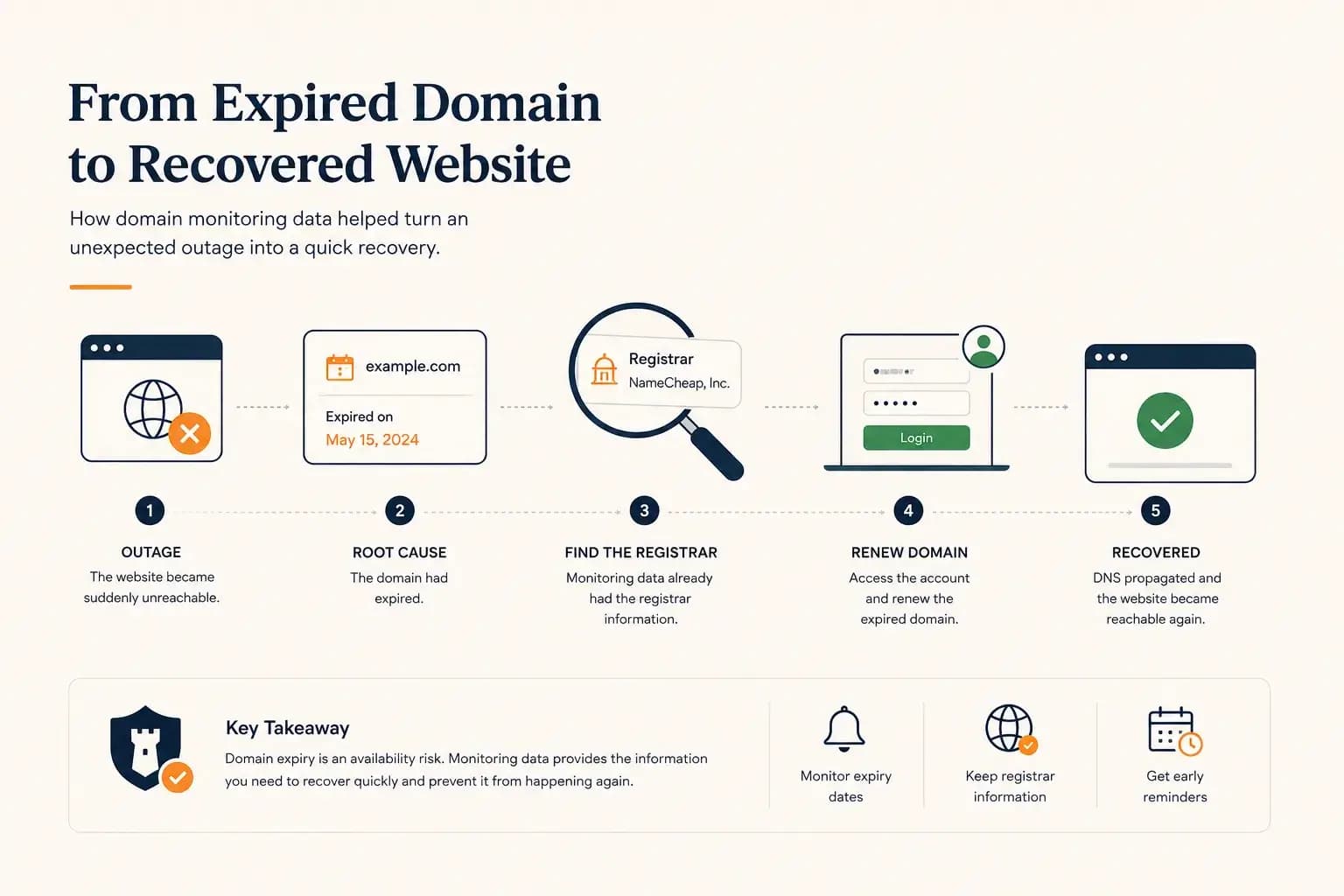
The Website Went Down — and the Owner Didn’t Know Where the Domain Was Registered...
A real-world expired domain recovery case: how a website went offline, how we identified the registrar from monitoring data, and how the domain was renewed before it was lost.
Learn more about The Website Went Down — and the Owner Didn’t Know Where the Domain Was Registered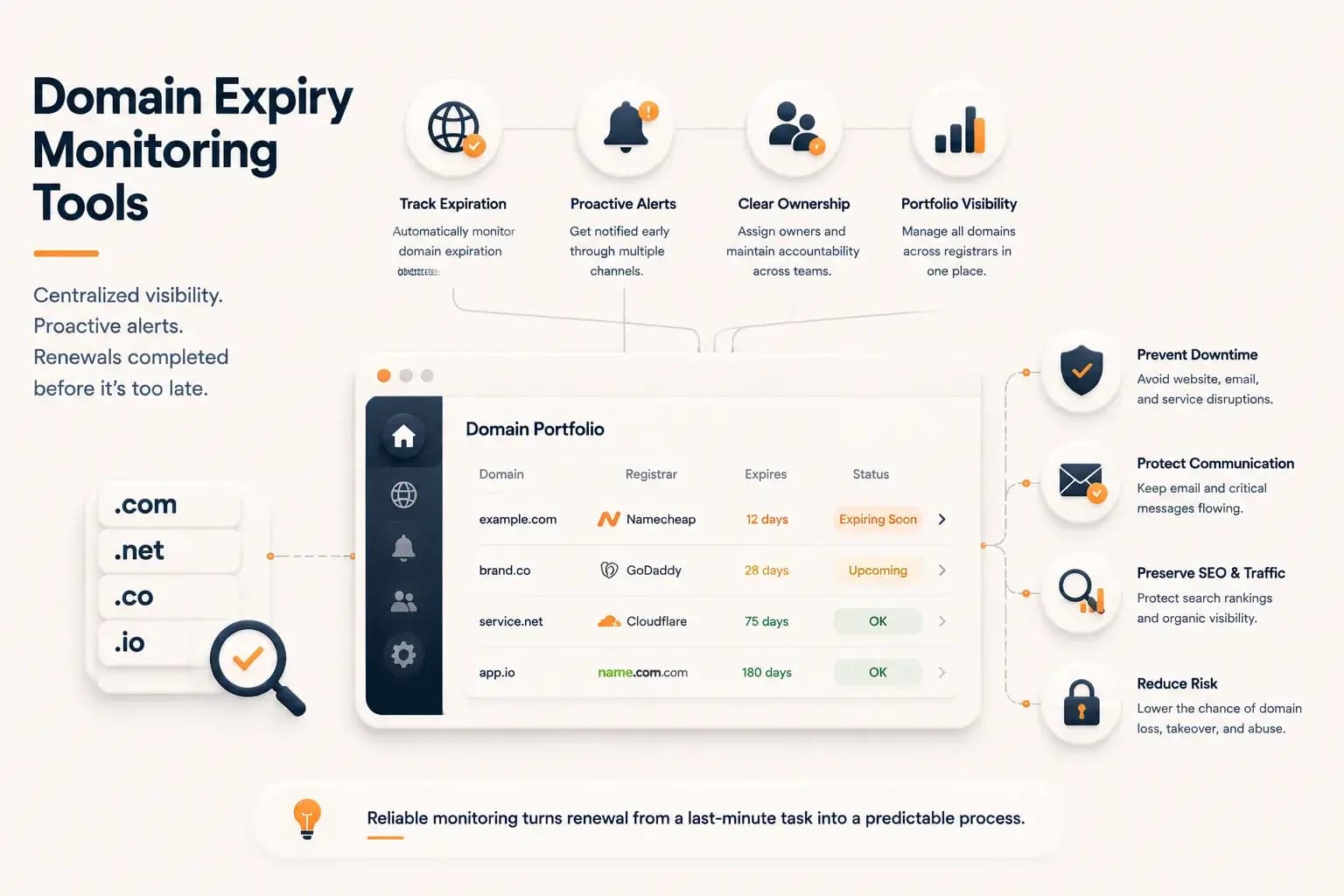
Best Domain Expiry Monitoring Tools: How to Choose the Right Solution...
Explore how domain expiry monitoring tools help organizations track renewal risks, manage multiple domains, and choose the right solution based on visibility, automation, and operational needs.
Learn more about Best Domain Expiry Monitoring Tools: How to Choose the Right Solution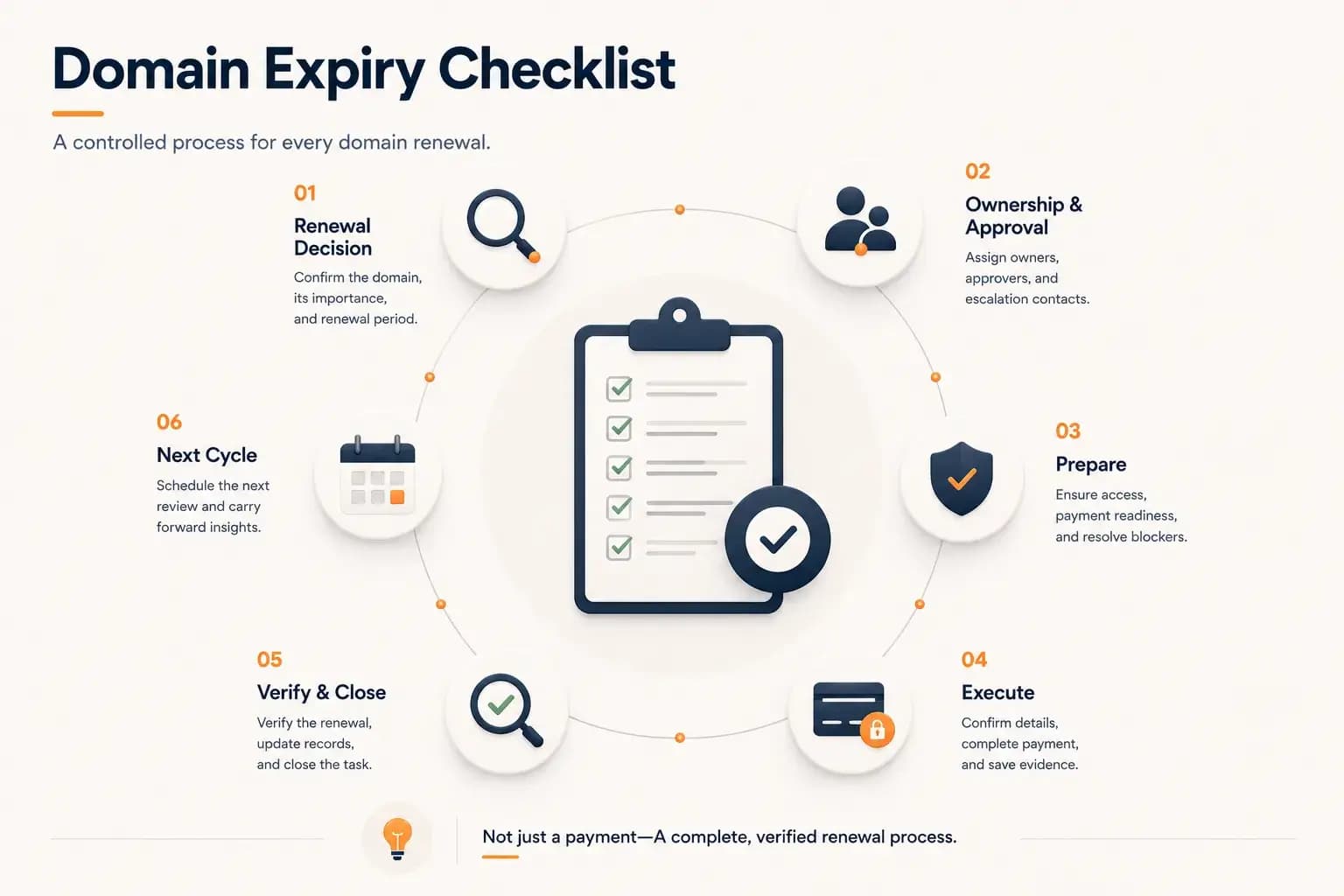
Domain Expiry Checklist: A Complete Renewal Process...
Follow a practical domain expiry checklist that standardizes every stage of the renewal process, from planning and ownership to execution, verification, documentation, and preparing the next renewal cycle. Learn how to reduce operational risk with a repeatable renewal workflow.
Learn more about Domain Expiry Checklist: A Complete Renewal Process