

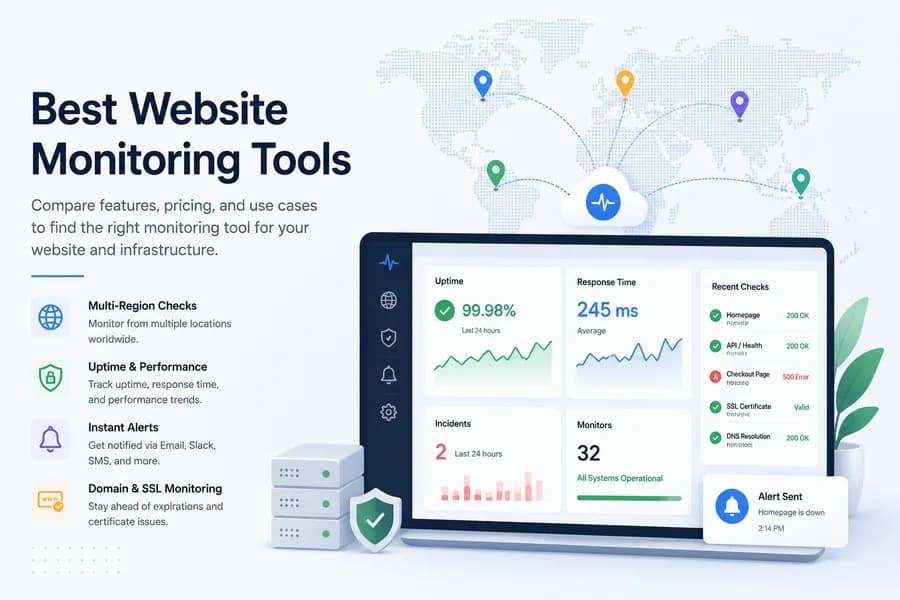
10 Best Website Monitoring Tools in 2026
- Watchman Tower Team
- Updated: August 18, 2026
- Category: Website Monitoring
- Read Time: 13 min
The best website monitoring tool depends on what happens after a failed check. This 2026 comparison evaluates five options across uptime coverage, alert quality, status communication, incident workflows, and infrastructure context.
Quick answer: There is no single best website monitoring tool for every team. Watchman Tower is a strong fit for agencies and operators who want website, SSL, domain, status-page, and optional server health signals in one place. UptimeRobot is easier to recommend for simple external checks and a generous free plan. Better Stack stands out for on-call and incident response, while Checkly is better suited to developer-owned synthetic monitoring. Uptime Kuma is the leading option for teams that want a free, self-hosted setup.
This guide compares tools for uptime, availability, performance, incident communication, and operational monitoring. It does not cover visual website-change detection tools that alert you when page content or design changes.
Disclosure: Watchman Tower is our product. To keep the comparison useful, every product is evaluated using the same criteria, and we include limitations and situations where another tool may be a better choice.
Last verified: August 2026. Features, limits, and prices were checked against publicly available vendor information. Pricing may vary by billing period, usage, region, taxes, and optional add-ons, so confirm final requirements on each vendor’s official website.
Best website monitoring tools at a glance
| Tool | Best for | Free option | Paid starting point | Main strength | Main limitation |
|---|---|---|---|---|---|
| Watchman Tower | Agencies and connected website health | 10 websites, 5-minute checks | $5.99/month | Website, domain, SSL, status, and optional server context | Smaller integration ecosystem than established platforms |
| UptimeRobot | Simple external monitoring | 50 monitors, 5-minute checks | $9/month with annual billing | Accessible setup and generous free allowance | Infrastructure diagnosis usually requires other tools |
| Better Stack | On-call and incident response | 10 monitors and heartbeats | Modular pricing; responder plans from $29/month annually | Monitoring connected to incident and telemetry workflows | Seat, usage, and module pricing takes time to compare |
| Uptime.com | Synthetic monitoring and formal reporting | No permanent free plan listed | $7/month | Transactions, APIs, page speed, RUM, and SLA reporting | More platform than basic uptime use cases need |
| StatusCake | Broad monitoring for small and midsize teams | 10 uptime monitors, 5-minute checks | $20.41/month | Uptime, page speed, SSL, domain, and server checks | Faster checks and higher limits require a paid tier |
| Oh Dear | Agencies managing website health | 10-day trial | €15/month for 2 sites | Uptime, broken links, SSL, domain, and performance monitoring | No permanent free tier and a higher entry price |
| Checkly | Developers and monitoring as code | 10 uptime monitors | $24/month with annual billing | Playwright, API checks, and infrastructure-as-code workflows | More technical than conventional uptime platforms |
| Pingdom | Synthetic monitoring and real-user performance | Trial only | $10/month per main product | Mature uptime, transaction, and performance monitoring | Synthetic monitoring and RUM are priced separately |
| Site24x7 | All-in-one IT operations monitoring | Free plan available | $9/month | Website, server, network, cloud, APM, and RUM coverage | Broad interface and configuration can feel complex |
| Uptime Kuma | Self-hosted uptime monitoring | Free and open source | Hosting and maintenance costs only | Control, privacy, and flexible notification support | You operate, secure, back up, and distribute it yourself |
The prices above are entry points at the time of review, not estimates for a complete production deployment. Your actual cost may depend on monitor count, check frequency, data retention, users, locations, SMS or phone alerts, synthetic browser runs, and additional telemetry.
How we evaluated the tools
This is an editorial comparison based on publicly documented product capabilities, plan limits, and intended workflows. It is not a claim that every platform was tested under identical laboratory conditions.
We considered six areas:
- Monitoring coverage: HTTP and HTTPS, ping, ports, keywords, APIs, SSL certificates, domains, heartbeats, transactions, and browser checks.
- Verification: check frequency, monitoring regions, outage confirmation, and protection against false positives.
- Alerting: supported channels, escalation, recovery notifications, maintenance windows, and noise control.
- Diagnostic depth: response-time history, error evidence, performance data, infrastructure telemetry, logs, and traces.
- Incident communication: status pages, incident history, subscribers, reports, and internal collaboration.
- Operating model: pricing, monitor limits, user seats, retention, integrations, hosting responsibility, and the cost of scaling.
The 10 best website monitoring tools in 2026
1. Watchman Tower: best for connected website and asset health
Watchman Tower is designed for teams that want more context than a basic “up or down” alert. Its external monitoring covers HTTPS, ping, ports, keywords, SSL certificates, and domain expiration. Paid plans add multi-region monitoring, faster checks, additional alert channels, and deeper reporting.
The main differentiator is the ability to connect website monitoring with optional server monitoring. This can help an operator investigate whether a slow or unavailable website is related to CPU, memory, disk, network, process, or heartbeat conditions on the underlying server.
- Best for: agencies, SaaS teams, infrastructure operators, and growing website portfolios.
- Why choose it: external checks, SSL and domain signals, status pages, and optional server context are available in one workflow.
- Trade-off: Watchman Tower has a smaller ecosystem than longer-established vendors. Some advanced status-page customization capabilities are still developing.
- Pricing: the Free plan supports 10 websites with five-minute checks. Paid plans start at $5.99 per month. Server monitoring begins on higher tiers. See the current plan limits.
2. UptimeRobot: best for accessible external monitoring
UptimeRobot remains one of the easiest services to recommend when the requirement is conventional external monitoring without a complicated setup. It supports HTTP, ping, port, keyword, API, DNS, SSL, domain-expiration, and related availability checks.
Its Free plan is especially attractive for personal websites and small portfolios because it includes 50 monitors. Paid plans add faster intervals, longer retention, more status-page capabilities, additional integrations, and team features.
- Best for: individuals and teams that primarily need reliable external uptime alerts.
- Why choose it: the product is approachable, widely used, and offers substantial free monitor capacity.
- Trade-off: it tells you whether an endpoint is failing, but detailed infrastructure diagnosis normally remains in separate server or observability tools.
- Pricing: Free includes 50 monitors with five-minute checks. Paid plans start at $9 per month with annual billing.
If these are the two products on your shortlist, see our detailed Watchman Tower vs UptimeRobot comparison for a closer look at monitoring coverage, check intervals, alerts, status pages, and pricing.
3. Better Stack: best for on-call and incident-response workflows
Better Stack combines uptime monitoring with on-call scheduling, incident management, status pages, logs, metrics, traces, and error tracking. Its strongest use case is not merely detecting a failure but routing it into an engineering response process.
Monitoring features include uptime and heartbeat checks, multi-location verification, SSL and domain signals, screenshots, traceroute information, and incident timelines. Phone and SMS alerting can be connected to responder schedules and escalation rules.
- Best for: engineering teams that want monitoring and incident response in the same ecosystem.
- Why choose it: strong on-call workflows and the option to add broader observability data.
- Trade-off: pricing is divided across responder licenses, monitors, telemetry, and other modules. Estimating total cost requires modeling the intended deployment.
- Pricing: a Free plan includes 10 monitors and heartbeats. Paid responder plans start at $29 per responder per month with annual billing, with monitoring and telemetry capacity priced separately.
4. Uptime.com: best for synthetic monitoring and reporting depth
Uptime.com provides basic uptime checks alongside API monitoring, transaction monitoring, page-speed tests, real-user monitoring, SLA reporting, maintenance controls, and global monitoring locations.
It is a stronger candidate than a lightweight uptime service when a team needs to validate complete user journeys, create formal availability reports, or compare performance across locations.
- Best for: established organizations with synthetic transaction, reporting, or geographic-performance requirements.
- Why choose it: broad synthetic capabilities and reporting are available within one commercial platform.
- Trade-off: teams that only want basic uptime alerts may pay for and manage more functionality than they need.
- Pricing: website monitoring plans start at $7 per month. Included checks, SMS allowances, and advanced capabilities vary by plan.
5. StatusCake: best for broad monitoring without a full observability platform
StatusCake sits between basic uptime services and larger observability platforms. In addition to availability monitoring, it offers page-speed, domain, SSL, and server monitoring.
This makes it useful for small and midsize teams that want to watch several aspects of a website without adopting a platform centered on logs, traces, and application performance management.
- Best for: agencies and small teams that need several website-health checks from one provider.
- Why choose it: useful breadth across uptime, performance, certificates, domains, and servers.
- Trade-off: one-minute checks, higher monitor allowances, and several reporting features require a paid plan.
- Pricing: Free includes 10 uptime monitors with five-minute checks. The Superior plan starts at approximately $20.41 per month with annual billing.
6. Oh Dear: best for agencies managing complete website health
Oh Dear monitors more than availability. Its feature set includes uptime, SSL certificates, domain expiration, broken links, mixed content, Lighthouse performance, cron jobs, DNS, status pages, and related website-health signals.
Plans are primarily based on the number of monitored sites, and the company makes the full feature set available across plans. That structure is easy to understand for agencies, although its entry price is higher than basic uptime-only products.
- Best for: web agencies and development teams responsible for maintaining multiple client websites.
- Why choose it: broken-link and site-quality checks complement uptime, certificate, and domain monitoring.
- Trade-off: there is no permanent free plan, and teams that only need a few simple uptime checks can find cheaper alternatives.
- Pricing: a 10-day trial is available. Paid plans start at €15 per month for two sites.
7. Checkly: best for developers and monitoring as code
Checkly is built for engineering teams that want API and browser checks to live close to application code. It supports Playwright-based browser monitoring, API checks, uptime protocols, private locations, a command-line workflow, and infrastructure-as-code tools such as Terraform and Pulumi.
Checkly is particularly useful when monitoring should be reviewed, versioned, and deployed like software. It is less compelling for a nontechnical operator who only wants to enter a URL and receive basic downtime alerts.
- Best for: developers, platform teams, and organizations adopting monitoring as code.
- Why choose it: strong Playwright, API, CI/CD, and programmable monitoring workflows.
- Trade-off: browser-run and API-run allowances add another dimension to capacity planning, and the workflow assumes more technical involvement.
- Pricing: the Hobby plan includes 10 uptime monitors. Paid plans start at $24 per month with annual billing.
8. Pingdom: best for established synthetic and real-user monitoring
Pingdom is a long-established name in website monitoring. Its synthetic product covers uptime, page speed, and transaction monitoring, while its real-user monitoring product measures the experiences of actual visitors.
It remains relevant for organizations that want a mature commercial service with performance reporting, public reports, maintenance controls, and common alerting channels.
- Best for: teams that need recognizable, established synthetic monitoring and optional RUM.
- Why choose it: mature uptime, transaction, page-performance, and real-user monitoring capabilities.
- Trade-off: synthetic monitoring and real-user monitoring are separate products, so a complete implementation can cost more than the initial price suggests.
- Pricing: Synthetic Monitoring and Real User Monitoring each start at $10 per month. A trial is available.
9. Site24x7: best for all-in-one IT operations monitoring
Site24x7 extends far beyond website uptime. Its platform covers websites, servers, networks, cloud environments, applications, synthetic transactions, real-user monitoring, logs, and related IT operations use cases.
This breadth can reduce the number of separate monitoring products used by an IT department. It can also create more configuration and interface complexity than a website owner needs for a handful of endpoints.
- Best for: IT teams that want website monitoring inside a broader infrastructure and application-monitoring suite.
- Why choose it: unusually broad coverage at a relatively accessible entry price.
- Trade-off: plan allowances cover different monitor types, and the overall platform requires more evaluation than a focused uptime service.
- Pricing: a Free plan is available. Paid all-in-one plans start at $9 per month, with capacity varying by plan and monitor type.
10. Uptime Kuma: best free self-hosted monitoring tool
Uptime Kuma is a free, open-source monitoring application that you run on your own infrastructure. It supports HTTP and HTTPS, TCP, ping, DNS, keywords, JSON queries, WebSockets, push monitors, Docker containers, certificate information, status pages, and numerous notification services.
Self-hosting provides control over data and configuration, but the software is only one part of the operating cost. Your team remains responsible for hosting, upgrades, security, backups, availability, and any multi-region deployment.
- Best for: technical users who want a capable self-hosted uptime dashboard.
- Why choose it: no software subscription, short monitoring intervals, broad notification support, and control over the deployment.
- Trade-off: there is no managed operations team behind your installation. Reliable multi-region verification requires additional instances and your own architecture.
- Pricing: the software is free. Hosting, maintenance, backup, messaging, and engineering time remain your responsibility.
Which website monitoring tool is best for your use case?
Best for a personal website or small free setup
Start with UptimeRobot or StatusCake if you want a hosted service with a useful free allowance. Choose Uptime Kuma if you already operate a server and prefer a self-hosted application.
Best for agencies and website portfolios
Watchman Tower is a strong fit when uptime, SSL, domain expiration, status communication, and optional server health need to be viewed together. Oh Dear is especially compelling when broken links and broader website-quality checks are part of the maintenance service. StatusCake is another practical option for mixed website-health checks.
Best for on-call engineering teams
Better Stack is the clearest match when the buying decision is driven by escalation policies, responder schedules, phone alerts, incident management, and connections to logs or other telemetry.
Best for monitoring as code
Checkly is the strongest choice when browser and API checks should be versioned with application code, deployed through CI/CD, and managed with development tools.
Best for synthetic transactions and performance reporting
Uptime.com and Pingdom both cover more advanced synthetic and performance requirements. Uptime.com is attractive for broad reporting and transaction workflows, while Pingdom offers an established combination of synthetic and real-user monitoring products.
Best for all-in-one IT monitoring
Site24x7 is the most natural candidate when website availability is only one part of a larger server, network, cloud, application, and IT operations requirement.
Best for self-hosting
Uptime Kuma offers the most direct route to a capable self-hosted monitoring dashboard. Choose it when control and customization justify the operational responsibility.
How to choose a website monitoring tool
The best choice depends less on the length of a feature list and more on what must happen after a check fails.
- Define what you need to monitor. A public website may only require HTTPS and SSL checks. A SaaS product may also need API, transaction, heartbeat, DNS, port, and server monitoring.
- Check how outages are confirmed. Multiple locations and confirmation checks help distinguish a real outage from a temporary regional or monitoring-node problem.
- Compare intervals carefully. A five-minute interval can be adequate for a personal site but too slow for a service with strict availability commitments.
- Inspect the alert, not just the channel list. Useful alerts should include the failed check, error evidence, timing, location, and recovery state. Escalation and noise controls matter as the team grows.
- Decide how much diagnosis belongs in the platform. Some teams only need an external signal. Others benefit from server metrics, browser evidence, logs, traces, or network diagnostics.
- Evaluate status communication. Check whether status pages support the number of services, subscribers, domains, branding, access controls, and incident history you require.
- Calculate the production price. Model your real number of monitors, locations, users, check frequency, retention, browser runs, SMS messages, and status pages rather than comparing entry prices alone.
- Account for operational ownership. Self-hosted software can reduce subscription costs, but hosting, maintenance, upgrades, backups, security, and redundancy still have a cost.
Test the shortlist before committing
Run the same controlled test in each shortlisted product. Monitor one healthy production endpoint, one intentionally failing endpoint, one SSL certificate, one slow response, and, if applicable, one API or browser transaction.
Compare detection time, false positives, the evidence included in alerts, recovery notifications, incident communication, reporting, and the effort required to identify the probable cause. Then calculate the cost using the monitor count and check frequency you expect to need in 12 months.
If you are creating the process from scratch, read our uptime monitoring guide and 12-step monitoring checklist. To evaluate Watchman Tower directly, review its uptime monitoring capabilities and current plan limits.
Free plan available. No credit card needed.
FAQ
What is the best website monitoring tool for agencies?v
Which website monitoring tool has the best free plan?v
What is the best self-hosted website monitoring tool?v
Which tool is best for on-call engineering teams?v
What is the best website monitoring tool for developers using monitoring as code?v
Which tool is best for synthetic monitoring and performance reporting?v
Blog Posts
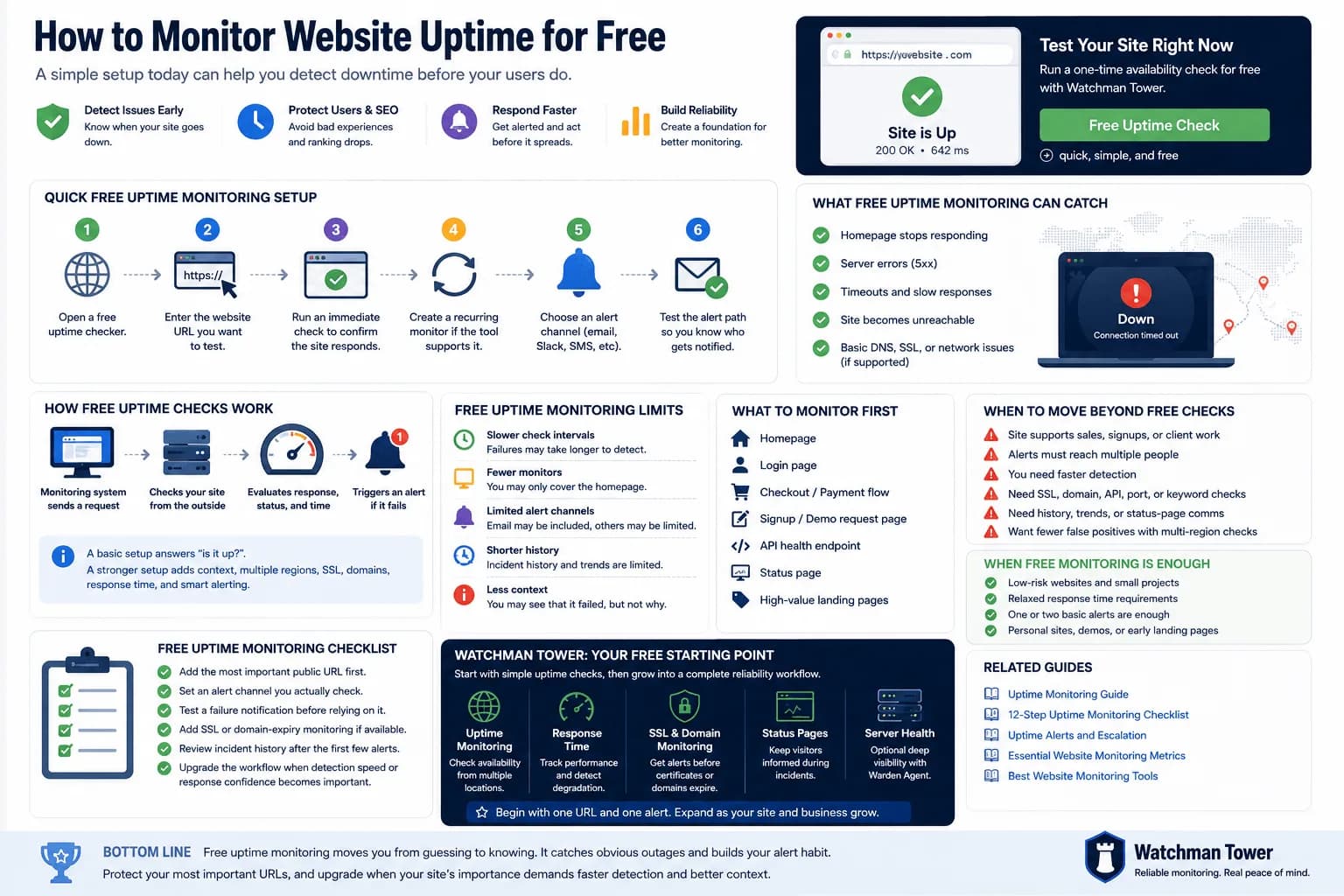
Monitor Website Uptime for Free: Setup, Limits, and Next Steps...
You can monitor website uptime for free by adding your URL to a basic checker, choosing an interval, and enabling alerts. This guide explains the fastest setup, what free checks can catch, and where free monitoring starts to fall short.
Learn more about Monitor Website Uptime for Free: Setup, Limits, and Next Steps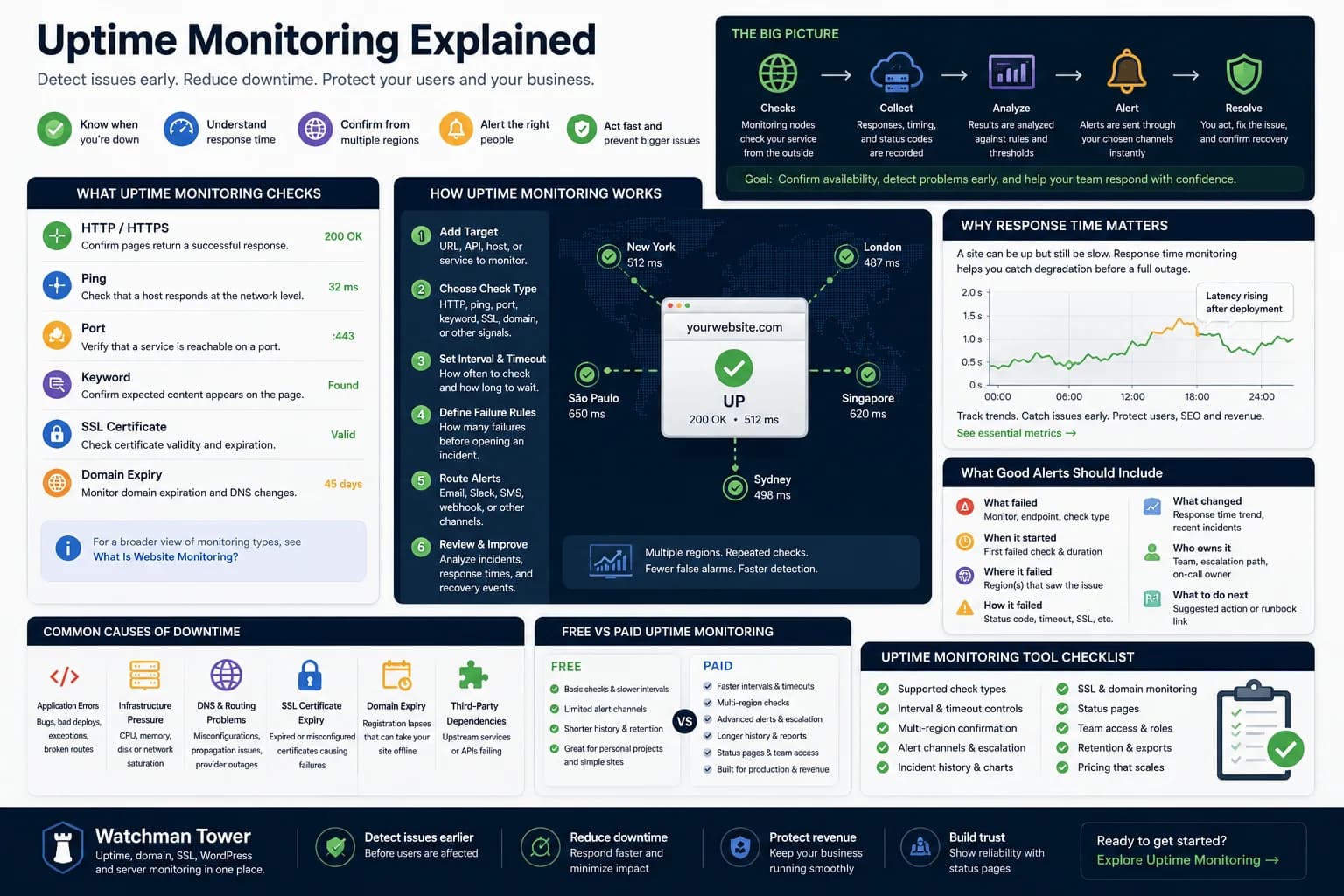
Uptime Monitoring Guide: How to Detect Downtime and Alert Faster...
Uptime monitoring helps you detect when a website, app, or service becomes unavailable. This guide explains how checks work, which signals matter, how alerts should be routed, and how to turn basic uptime checks into a practical response workflow.
Learn more about Uptime Monitoring Guide: How to Detect Downtime and Alert Faster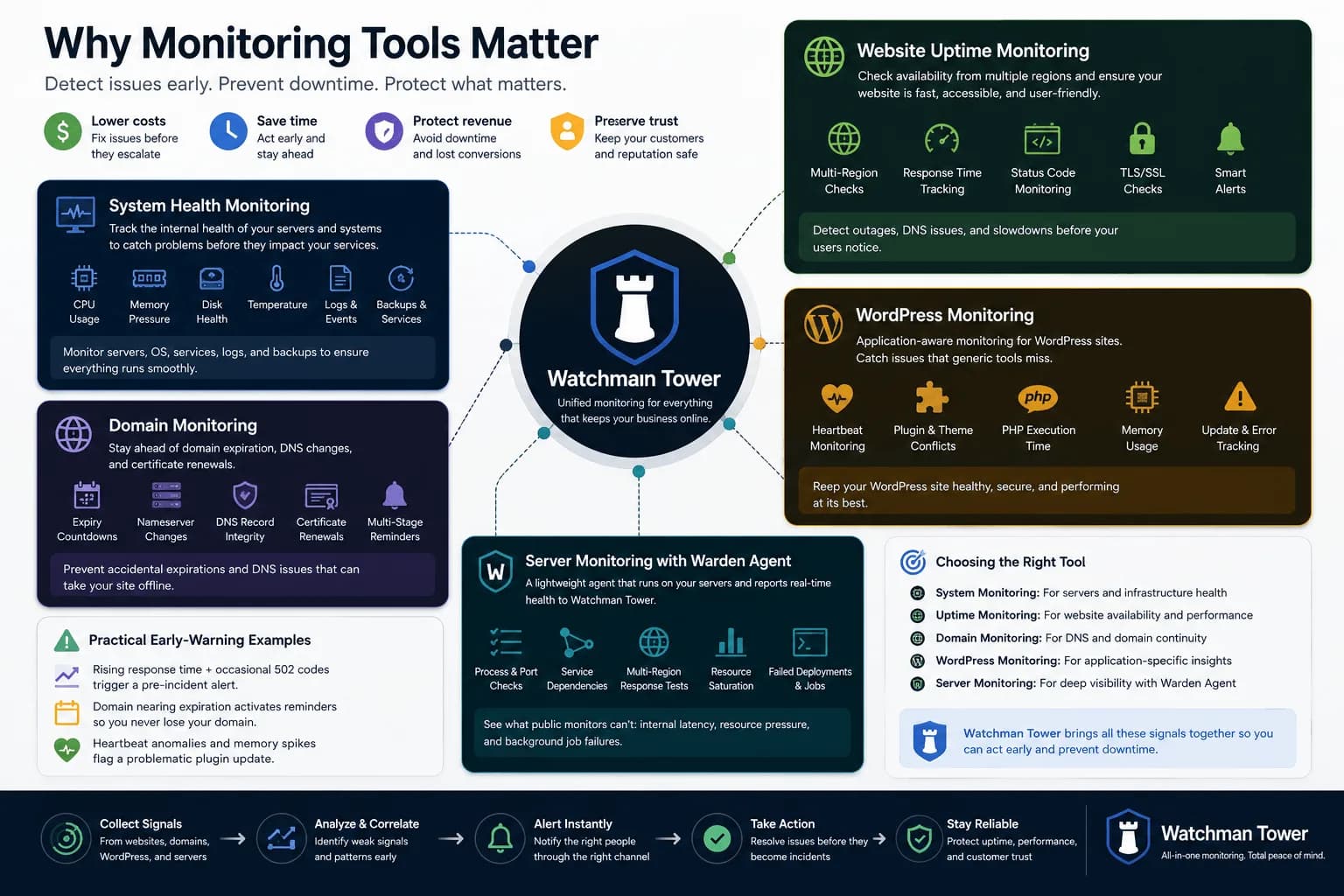
Different Types of Monitoring Tools: From System Health to Website Uptime...
Monitoring tools have expanded far beyond one-dimensional checks. This guide explains the main tool categories and where broader health visibility starts to matter.
Learn more about Different Types of Monitoring Tools: From System Health to Website Uptime