

Watchman Tower vs UptimeRobot: 2026 Monitoring Comparison
- Watchman Tower Team
- Updated: September 6, 2026
- Category: Website Monitoring
- Read Time: 10 min
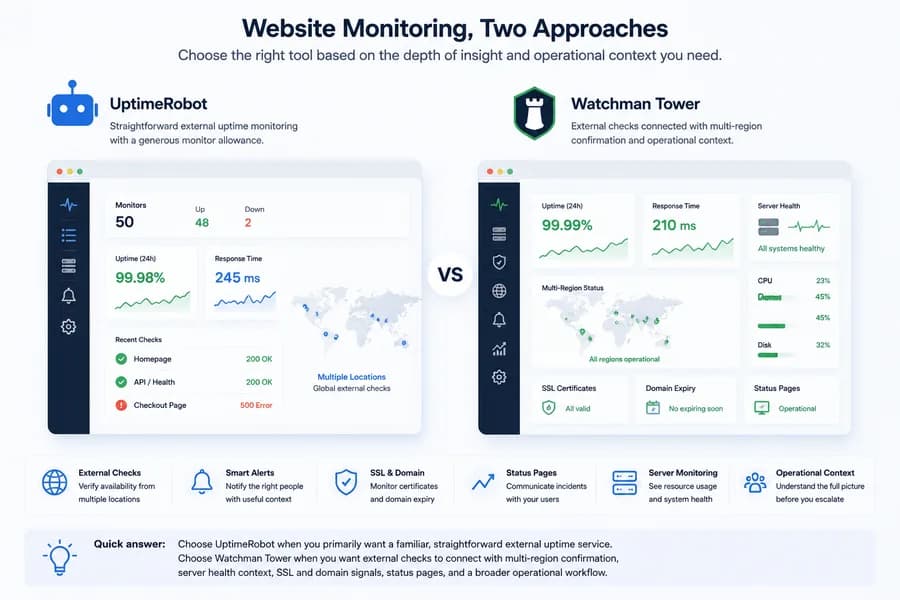
Watchman Tower and UptimeRobot both monitor website availability, but they are designed for different operational depths. This 2026 comparison explains where each platform fits across uptime checks, alerting, status pages, server context, and team workflows.
Quick answer: In the Watchman Tower vs UptimeRobot comparison, UptimeRobot is the better choice for a generous free plan, broader external check types, mature status pages, and monitoring intervals as short as 15 seconds on self-service plans. Watchman Tower is a better fit for agencies and operators who want lower-cost paid website monitoring combined with SSL, domain, status-page, and optional server-health signals.
Disclosure: Watchman Tower is our product. This comparison uses the same criteria for both platforms and identifies the areas where UptimeRobot provides the stronger option.
Last verified: August 2026. Features and prices were checked against publicly available product information. Confirm current limits on the official Watchman Tower pricing page and UptimeRobot pricing page before purchasing.
If you are still comparing the wider market, start with our guide to the best website monitoring tools.
Watchman Tower vs UptimeRobot at a glance
| Comparison area | Watchman Tower | UptimeRobot | Advantage |
|---|---|---|---|
| Best suited to | Agencies and operators connecting website and server health | Individuals and teams needing established external monitoring | Depends on workflow |
| Free allowance | 10 websites | 50 monitors | UptimeRobot |
| Free check interval | 5 minutes | 5 minutes | Tie |
| Paid starting price | $5.99/month | From $12/month with annual billing | Watchman Tower |
| Fastest standard interval | 30 seconds on Stack | 15 seconds on Scale | UptimeRobot |
| External check coverage | HTTPS, SSL, and domain expiry | HTTP, ping, port, keyword, API, UDP, DNS, SSL, domain, heartbeat, and related checks | UptimeRobot |
| Multi-region monitoring | Available on all plans, including Free | Location-specific and multi-location capabilities vary by plan | Both |
| Native server metrics | Available from the Solo plan | Not designed as a host-metrics platform | Watchman Tower |
| Status pages | Integrated status pages currently in beta | Mature public, custom-domain, private, and white-label options across plans | UptimeRobot |
| Mobile applications | Official iOS and Android applications with push notifications | Official iOS and Android applications | Both |
| Longest listed retention | Up to 365 days | Up to 24 months on self-service plans | UptimeRobot |
Monitor allowances are not always directly equivalent. Watchman Tower describes its limits in websites, while UptimeRobot uses monitors. A single website can require several monitors if you separately check its homepage, API, ports, certificates, and background jobs.
The main difference
UptimeRobot is primarily an external monitoring platform. It checks websites, endpoints, ports, APIs, DNS, certificates, domains, and recurring jobs from outside your infrastructure. Its strength is a mature, accessible monitoring service with a broad check catalogue and a large free allowance.
Watchman Tower approaches monitoring as connected asset health. External availability checks can be viewed alongside SSL certificates, domain expiration, response-time signals, status communication, and, on supported plans, server telemetry.
This means the decision is not simply about which platform can detect downtime. Both can do that. The more useful question is whether you want a focused external monitoring service or a workflow that can connect external failures with selected infrastructure signals.
Free plan comparison
UptimeRobot Free
UptimeRobot has the stronger free plan for monitor capacity. It includes 50 monitors with five-minute checks, core external monitor types, limited integrations, and a basic status page. No credit card is required, and the plan can be used for commercial projects as well as personal sites.
It is a practical starting point for personal websites, small businesses, open-source projects, freelancers, and teams that need basic alerts without an immediate monitoring budget.
Watchman Tower Free
Watchman Tower Free includes 10 websites, all three monitoring regions, five-minute checks, email alerts, basic analytics, SSL and domain signals, and up to seven days of uptime logs
It provides an accessible way to evaluate the Watchman Tower workflow, but it does not compete with UptimeRobot’s free monitor count. Slack alerts, longer retention, and advanced analytics begin on paid plans. Native server monitoring starts on the Solo plan.
Free-plan winner: UptimeRobot. Its 50-monitor allowance and longer listed retention provide more room for a zero-cost deployment.
Paid plan and pricing comparison
| Requirement | Watchman Tower | UptimeRobot |
|---|---|---|
| Entry paid plan | Solo: $5.99/month | Solo: from $12/month with annual billing |
| Included capacity at entry | 50 websites | Capacity selected by monitor tier |
| Entry paid interval | 60 seconds | 60 seconds |
| Team-oriented plan | Team: $19.99/month | Team: $34/month with annual billing |
| Fastest self-service interval | 30 seconds | 15 seconds |
| Server monitoring | 1 server agent on Solo; 5 on Team; 50 on Stack | Requires a separate infrastructure-monitoring product |
Watchman Tower has the lower paid entry point, particularly for operators managing a portfolio of conventional websites. Its Solo plan includes 50 websites, multi-region monitoring, one-minute checks, Slack alerts, advanced analytics, and 30 days of performance data.
UptimeRobot becomes more compelling when the requirement includes a wider selection of external monitor types, established integrations, mature status pages, mobile applications, longer retention, team access, or intervals shorter than 30 seconds.
Do not compare subscription prices using monitor count alone. Calculate the cost using the number of endpoints, certificates, domains, jobs, team members, alert contacts, status pages, and monitoring regions you will actually use.
Website and endpoint monitoring
Both products cover the monitoring foundations required by most websites, including HTTPS availability, response time, SSL certificates, and domain expiration. UptimeRobot additionally offers ping, port, and keyword checks, which Watchman Tower does not currently provide.
UptimeRobot currently offers the broader external check catalogue. Depending on the plan, it includes API monitoring with authentication and JSON validation, UDP checks, DNS monitoring, heartbeat monitoring, location-specific checks, slow-response thresholds, and configurable HTTP behavior.
Watchman Tower covers common website and infrastructure entry points but does not currently match UptimeRobot’s complete range of specialized external monitor types. Teams requiring advanced API validation, UDP checks, or an established heartbeat workflow should confirm whether Watchman Tower supports their exact scenario before migrating.
External monitoring winner: UptimeRobot.
Check intervals and outage confirmation
Both Free plans use five-minute checks, while their entry paid plans reduce the interval to 60 seconds.
Watchman Tower reaches 30-second monitoring on its Stack plan. UptimeRobot offers 30-second checks on Team and 15-second checks on Scale, while Enterprise customers can discuss custom intervals.
Both platforms provide regional monitoring capabilities, so multi-location checking is not unique to Watchman Tower. The important comparison is how many locations your selected plan supports, how results from those locations are interpreted, and whether the platform confirms a failure before notifying your team.
Teams with strict detection-time requirements should also remember that monitoring interval is not the same as guaranteed alert time. Confirmation logic, request timeout, retry behavior, notification processing, and the selected alert channel all affect when a person receives the incident.
Interval winner: UptimeRobot, because its Scale plan offers 15-second checks.
Server monitoring and diagnostic context
This is the clearest architectural difference between the two products.
Watchman Tower can add native server monitoring from the Team plan. Available signals include CPU usage, top processes, RAM, disk usage, network metrics, heartbeat freshness.
If a website slows down or becomes unavailable, these signals can help determine whether the incident overlaps with resource pressure or missing data from the server. They do not replace logs, traces, application performance monitoring, or a full root-cause investigation, but they provide more context than an external check alone.
UptimeRobot is primarily focused on external availability and service checks. It can check whether a server responds over ping or a selected port, but it is not intended to provide native CPU, memory, disk, process, and network telemetry from the host.
This is not a disadvantage when a team already uses a separate infrastructure or observability platform. In that case, UptimeRobot can remain the external source of truth while another product provides internal diagnostics.
Native server-context winner: Watchman Tower.
Alerts and incident workflows
Watchman Tower provides email alerts on Free, adds Slack on Solo, and expands to SMS, push notifications, team collaboration, and higher notification quotas on Team and Stack.
UptimeRobot supports email and a broad integration catalogue, with Slack, Microsoft Teams, Telegram, webhooks, Zapier, PagerDuty, SMS, and voice capabilities varying by plan. SMS and voice calls use credits, some of which are included with paid plans and can also be purchased separately.
UptimeRobot has the advantage when you need an established selection of third-party alert integrations. Watchman Tower is more relevant when the alert should remain connected to server and asset-health signals within the same product.
Compare escalation behavior, repeated notifications, maintenance windows, recipient access, recovery alerts, and message quotas rather than counting channel logos.
Status pages
Both products can publish service health, but their current status-page maturity is different.
UptimeRobot supports basic status pages on Free. Paid plans expand into custom domains, branding, white-label presentation, password protection, subscriber notifications, translations, analytics, and larger status-page allowances.
Watchman Tower includes public status pages, but the feature is currently marked as beta. Custom domains are available; white-label branding is listed as coming soon, and the available customization ecosystem is not yet as extensive as UptimeRobot’s.
Status-page winner: UptimeRobot.
Data retention, reporting, and team access
Watchman Tower lists uptime-log retention of seven days on Free, 30 days on Solo, 90 days on Team, and 365 days on Stack. Performance-metric retention begins on Solo. CSV export is available on Solo, while CSV and API export are listed on Team and Stack.
UptimeRobot lists three months of retention on Free, 12 months on Solo, and 24 months on Team and Scale. It also provides monthly reports, API access, login seats, and notify-only seats according to the selected plan.
Watchman Tower’s team capabilities begin on its Team plan and are designed around shared website and server assets. UptimeRobot has a more mature separation between people who manage monitors and people who only receive alerts.
Retention and account-management winner: UptimeRobot for most teams. Watchman Tower remains relevant when server agents and website assets need to be managed together.
Choose Watchman Tower if you:
- manage a portfolio of websites, domains, SSL certificates, and servers;
- want a lower-cost paid entry point with one-minute, multi-region website monitoring;
- want optional CPU, RAM, disk, network, process, and heartbeat signals in the same platform;
- prefer connected asset health over a purely external uptime-monitoring workflow;
- do not require the broadest integration or status-page ecosystem.
Choose UptimeRobot if you:
- want up to 50 monitors without paying for a subscription;
- need API, UDP, DNS, heartbeat, location-specific, or advanced HTTP monitoring;
- require intervals as short as 15 seconds on a self-service plan;
- want mature status pages with custom domains, branding, subscribers, or private access;
- value longer retention and a larger integration ecosystem;
- already use another product for server metrics, logs, traces, and incident diagnosis.
Test both products with the same workload
Before choosing, configure the same small workload in both products:
- one healthy production website;
- one intentionally failing endpoint;
- one SSL certificate and domain-expiration check;
- one slow endpoint;
- one port or API check relevant to your application;
- the alert channels your team will use in production.
Compare detection and recovery time, false alerts, the evidence included in each notification, dashboard clarity, status-page workflow, and the cost at your expected monitor count. If server monitoring matters, the Solo plan already includes one server agent; Team and Stack raise the limit to 5 and 50.
Final verdict
UptimeRobot is the stronger general-purpose external monitoring service. It offers a more generous free plan, broader check coverage, faster top-tier intervals, mature status pages, longer retention, mobile applications, and a larger integration ecosystem.
Watchman Tower is the better fit for a narrower but important workflow: agencies and operators who want affordable paid website monitoring to connect with domains, SSL certificates, status communication, and optional native server signals.
Choose UptimeRobot when the priority is established external monitoring with minimal operational change. Choose Watchman Tower when the priority is bringing related website and infrastructure health signals into one operational view.
Explore Watchman Tower uptime monitoring, review its server monitoring capabilities, or compare current limits on the pricing page.
Free plan available. No credit card needed.
FAQ
Which is better, Watchman Tower or UptimeRobot?v
Which platform has the better free plan?v
Which is more affordable, Watchman Tower or UptimeRobot?v
Does Watchman Tower provide server monitoring?v
Which platform supports faster monitoring intervals?v
Which platform has better status pages?v
Does UptimeRobot support more monitoring types than Watchman Tower?v
Is Watchman Tower a good UptimeRobot alternative for agencies?v
Blog Posts
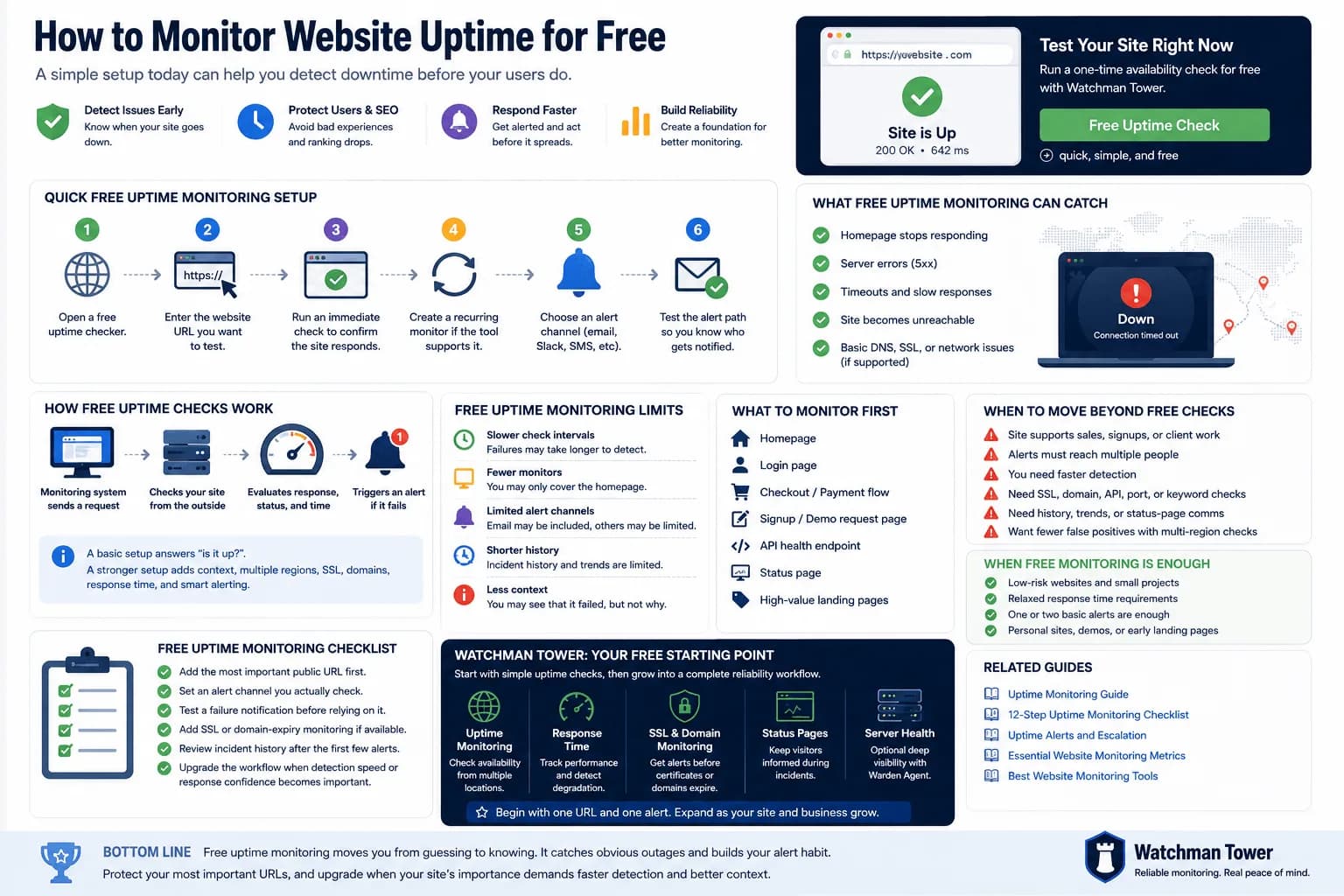
Monitor Website Uptime for Free: Setup, Limits, and Next Steps...
You can monitor website uptime for free by adding your URL to a basic checker, choosing an interval, and enabling alerts. This guide explains the fastest setup, what free checks can catch, and where free monitoring starts to fall short.
Learn more about Monitor Website Uptime for Free: Setup, Limits, and Next Steps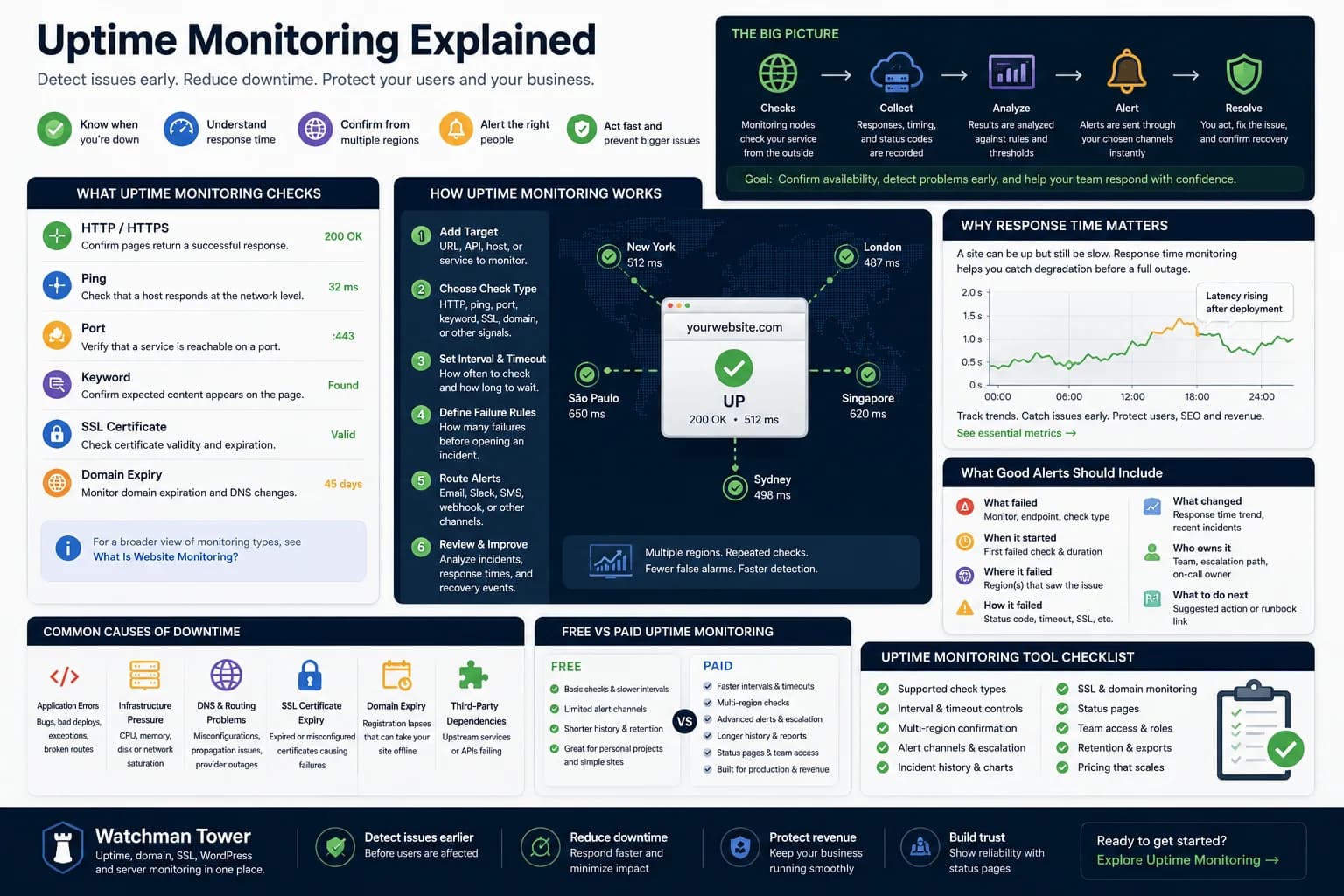
Uptime Monitoring Guide: How to Detect Downtime and Alert Faster...
Uptime monitoring helps you detect when a website, app, or service becomes unavailable. This guide explains how checks work, which signals matter, how alerts should be routed, and how to turn basic uptime checks into a practical response workflow.
Learn more about Uptime Monitoring Guide: How to Detect Downtime and Alert Faster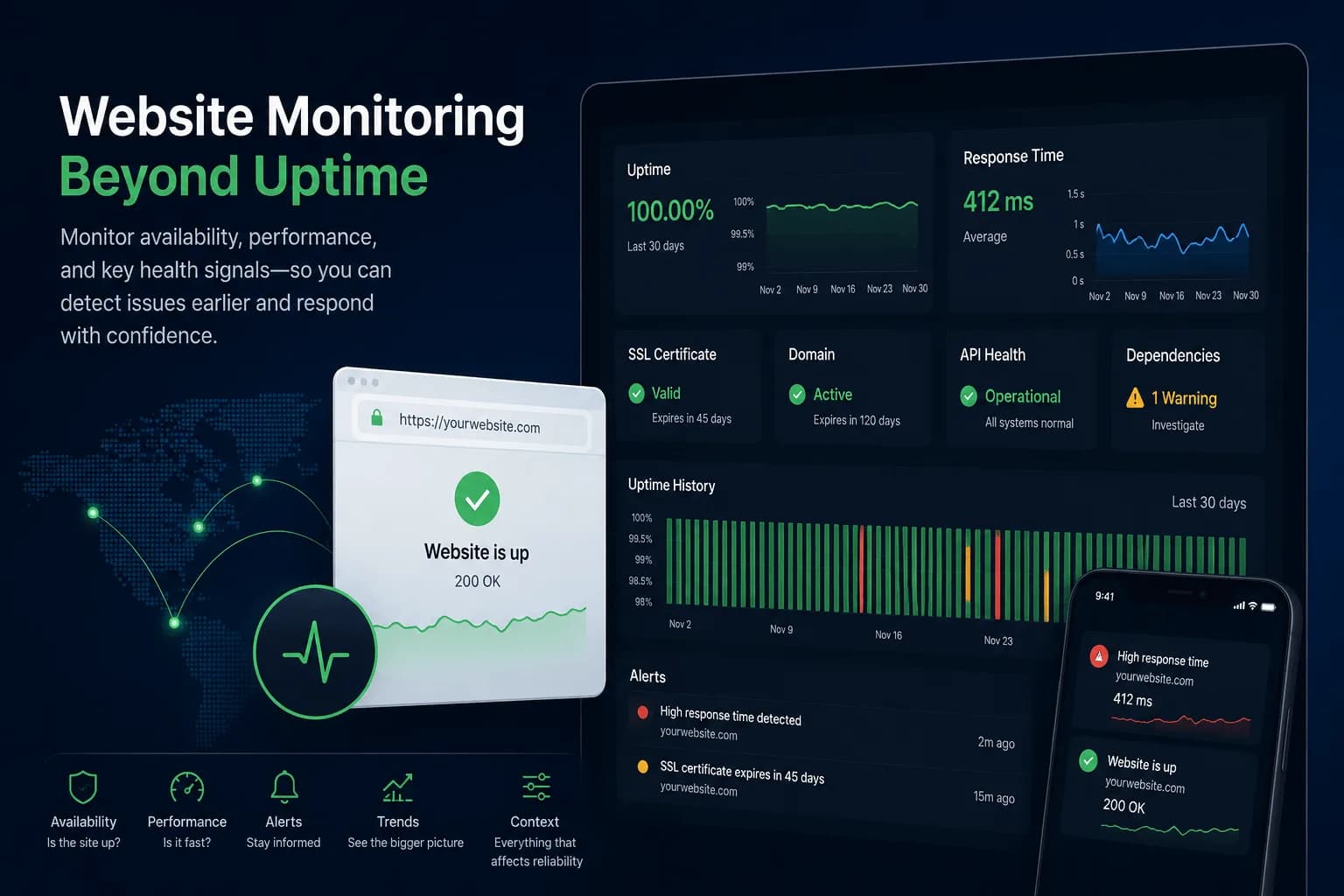
What Is Website Monitoring? How It Works and Why It Matters...
Website monitoring checks whether a site is available, how it performs and whether SSL, domain or dependency risks are building up around it. This guide explains how it works and how it differs from uptime monitoring.
Learn more about What Is Website Monitoring? How It Works and Why It Matters